Prop Firm Trading
Trailing Drawdown vs. Static Drawdown: The Prop Firm Rule That Kills Most Funded Accounts Before They Pay Out
The account is up $400. The morning session was clean. Two trades, two wins, clean exits both times. Risk was controlled, position sizing was correct, and the execution felt sharp. By any reasonable measure the day was going well.
Then the afternoon came. A stop-out for $150. Another for $200. Net P&L for the day: plus $50. Still green. No reason for concern, at least not by the logic most traders use.
Except the account blew.
This is the trailing drawdown trap, and it has ended more funded trading careers than any single bad trade. The rule does not care that you finished the day net positive. It cares that your peak equity was $400 higher than where you started, which means the maximum loss threshold had already tightened by $400 before you placed your afternoon trades. You spent the afternoon thinking you had $2,500 of breathing room. You actually had $700.
The most common way a prop firm account blows is not from a catastrophic loss. It is from a trader who understood the rule in theory but never ran the math during a live session.
This post breaks down exactly how trailing drawdown works, how it differs from static drawdown, how to calculate your real buffer at any point in a session, and how to build a session plan that accounts for whichever type your firm uses. If you are running a funded account or preparing for a challenge, this is the piece of the rules framework that is most frequently misunderstood and most consistently underestimated.
What Is a Trailing Drawdown in Prop Firm Trading?
A trailing drawdown is a maximum loss limit that follows your account equity upward as you profit. It locks in permanently at each new equity high and never comes back down. The floor tightens as you make money. The gap between your current balance and the floor stays roughly constant when you are at your peak, but the floor itself is now sitting higher than it was when you started.
Here is a concrete example using a hypothetical $50,000 evaluation account with a $2,500 trailing drawdown:
- Start of challenge: Account at $50,000. Loss floor at $47,500. Buffer: $2,500.
- After a $2,000 profit run: Account at $52,000. Floor has trailed up to $49,500. Buffer: still $2,500.
- After another $2,000 profit run: Account at $54,000. Floor now at $51,500. Buffer: still $2,500.
- After giving back $3,500: Account at $50,500. Floor is still $51,500. Buffer: negative. Account blown.
Notice the critical detail: when the account hit $50,500 at the end of that scenario, it was only $500 above the starting balance of $50,000. Under a naive reading, you might think you still had over $2,000 of room left. But the trailing floor had moved to $51,500, meaning you had already gone $1,000 below the floor by the time you got back to the $50,500 mark. The account was blown before it even got close to the original $47,500 threshold.
The Featured-Snippet Answer
A trailing drawdown is a loss floor that rises permanently as your account reaches new equity highs and never comes back down. The key formula is: Your real buffer at any moment = Current Equity minus (Peak Equity minus Max Drawdown Amount). At a $54,000 peak with a $2,500 max drawdown, your floor is $51,500. If your current equity is $52,000, your real buffer is only $500, not $2,500.
What Is a Static Drawdown?
A static drawdown, sometimes called a fixed drawdown or an end-of-day (EOD) drawdown in its softer form, sets one permanent loss floor at account creation. Regardless of how much you profit, the floor stays exactly where it started. You can double your account balance and the floor does not move by a single dollar.
Using the same $50,000 account with a $2,500 maximum drawdown under a static model:
- Start of challenge: Account at $50,000. Floor at $47,500. Buffer: $2,500.
- After a $4,000 profit run: Account at $54,000. Floor still at $47,500. Buffer: $6,500.
- After giving back $3,500: Account at $50,500. Floor still at $47,500. Buffer: $3,000.
Same profit, same giveback, completely different outcome. Under static drawdown the trader just had a rough afternoon but still has $3,000 of room. Under trailing drawdown the account was blown before the afternoon ended.
Static drawdown gives you the ability to be aggressive during the challenge phase, build a cushion, and then trade with a larger real buffer from inside that cushion. Investopedia's definition of drawdown describes the concept at the portfolio level, where the same distinction between fixed and trailing loss floors appears in professional risk management. Prop firms adapted both models for retail evaluation contexts, but the underlying mechanics are the same.
EOD Trailing vs. Intraday Trailing: The Rule Nobody Actually Reads
Within the category of trailing drawdowns, there is a critical distinction that many traders miss entirely: whether the trailing calculation happens in real time on every tick, or only once per day at session close.
Intraday Trailing Drawdown
Intraday trailing drawdown recalculates your loss floor continuously. Every time your account reaches a new high during the live session, including unrealized open-position profits, that new high becomes the trailing reference. This is the most restrictive version of the rule.
The implication is significant: if you open a trade and it moves $800 into profit unrealized, your loss floor may already have tightened by $800, even though the trade has not closed. If the trade then reverses and stops out for a $200 realized loss, you are not just down $200 from your session start. You are down $1,000 from the intraday peak. Depending on your firm's exact interpretation, that full $1,000 counts against your trailing floor.
Some firms apply intraday trailing only to closed equity, meaning unrealized profits do not move the floor. Others apply it to the entire account equity including open positions. This distinction should be in your firm's rulebook and is worth reading carefully before you assume one or the other.
EOD (End of Day) Trailing Drawdown
EOD trailing drawdown calculates the new loss floor once per day, at the close of the trading session, based on your closed account balance. It does not react to intraday swings. This gives traders considerably more flexibility during a session: you can be up $1,000 at 10am, give it all back by noon, and the floor has not moved a dollar because the day is not over yet.
However, that flexibility disappears permanently the moment you close a profitable day. A net $1,000 profit on Monday means Tuesday starts with the floor $1,000 higher than it was on Monday morning. You cannot undo that ratchet. Each profitable session tightens the floor for every session that follows.
Intraday Trailing: Most Restrictive
Floor updates on every tick, including unrealized equity highs. A morning run that reverses fully in the afternoon can still move your floor. You must track your session peak in real time, not just your net P&L.
EOD Trailing: More Flexible Intraday
Floor updates once at session close. You can absorb intraday swings without permanently moving the floor. But each profitable day's closed P&L ratchets the floor up for every future session. The risk compounds over time.
The Math at Different Profit Levels: Where Most Traders Lose Track
The reason trailing drawdown catches traders off guard is that the math changes every time you set a new equity high, and most traders are not recalculating mid-session. They start the day knowing their buffer and never update it. By mid-session they are operating on a number that no longer reflects reality.
Here is a step-by-step table showing how the real buffer shifts throughout a session on a hypothetical trailing drawdown account with a $2,500 maximum drawdown:
| Event | Current Equity | Peak Equity | Loss Floor | Real Buffer |
|---|---|---|---|---|
| Session opens | $50,000 | $50,000 | $47,500 | $2,500 |
| Win +$600 | $50,600 | $50,600 | $48,100 | $2,500 |
| Win +$500 | $51,100 | $51,100 | $48,600 | $2,500 |
| Loss -$300 | $50,800 | $51,100 | $48,600 | $2,200 |
| Win +$800 | $51,600 | $51,600 | $49,100 | $2,500 |
| Loss -$900 | $50,700 | $51,600 | $49,100 | $1,600 |
| Loss -$800 | $49,900 | $51,600 | $49,100 | $800 |
| Loss -$900 | $49,000 | $51,600 | $49,100 | BLOWN |
Notice that the final session in this table ended with a net P&L of negative $100 from the day's starting equity of $50,000. The account landed at $49,000, which is $900 below where the day started, but also $100 below the floor. The account blew on a day that most traders would describe as "I gave back almost nothing." The $1,600 of net profit from those morning wins evaporated the buffer down to near zero before the afternoon sequence ran it into the floor.
The trader who was not tracking peak equity would have looked at $49,900 before that final trade and thought they still had a $2,400 buffer from the starting balance. They had $800.
Why Good Days Are the Most Dangerous Sessions
The counterintuitive reality of trailing drawdown is that a strong morning creates the highest-risk afternoon. The more you made, the tighter your floor, and the more exposed you are to any reversal.
This is the opposite of how most traders experience risk psychologically. After winning in the morning, the natural feeling is confidence. The session went well. Execution was sharp. A trader in this state tends to loosen up: entries get slightly less selective, position size creeps up, stops get a little wider. They feel like they are trading with "house money."
Under trailing drawdown, that exact psychological state arrives at the exact moment the floor is tightest. After a $1,600 morning run, you may feel invincible. But your afternoon buffer is $900, not $2,500. The morning wins bought you nothing in terms of protective room. The floor followed every dollar of it.
Professionals who trade trailing drawdown accounts operate with an explicit rule: after any meaningful morning profit, recalculate the real buffer before placing another trade. Do not open the afternoon session using your starting-equity buffer. Open it using the buffer you actually have, which is calculated from your morning peak.
The Mental Accounting Error That Blows Accounts
Most traders use two numbers: their current P&L for the day (how much they made or lost) and their max drawdown (the rule set by the firm). They subtract the former from the latter to estimate safety. On a net-down day, they feel they are approaching danger. On a net-up day, they feel they are away from danger.
This mental model is wrong for trailing drawdown accounts. The correct mental model tracks three numbers: current equity, peak equity for the session, and the firm's max drawdown amount. The actual buffer is always the difference between current equity and peak equity minus max drawdown. Net P&L for the day is irrelevant. Net P&L from peak is everything.
How Prop Firms Structure These Rules in Practice
Prop firms use a mix of trailing and static drawdown depending on the phase of the account. Understanding which rule applies at which stage changes how you should manage risk throughout the entire challenge-to-payout cycle.
Challenge and Evaluation Phase
Most evaluation accounts, the initial challenge phase where traders are trying to hit a profit target, use trailing drawdown. The rationale is risk limitation for the firm: if a trader takes large early profits and then blows up, the trailing floor caps how far they can fall before being removed from the evaluation. From the firm's perspective, trailing drawdown discourages reckless gambling on a fresh account because good early performance reduces the room available for disaster later.
Funded Phase
Many firms convert successful traders to a static or locked-floor drawdown model once they pass the challenge. The trailing floor stops following equity at the moment the profit target is reached, typically locking at or above the starting balance. From that point forward, the floor is fixed. This shift is significant: a trader in the funded phase now has the ability to build a real cushion above a fixed floor, which changes the risk calculus considerably.
Understanding exactly when this lock triggers is critical for the final stretch of a challenge. Some firms lock the floor at the moment the account first touches the profit target in equity, even intraday. Others lock at the end of the day when the target is met on closed P&L. Read the exact rule for your firm and test edge cases before you assume the lock has applied.
The EOD Rule as a Middle Ground
Some firms use EOD trailing specifically as a softer version designed to reduce intraday stress while still applying a ratchet mechanism over time. These accounts allow you to recover from intraday drawdowns without moving the floor, but each positive day's closed equity becomes the new permanent reference. The cumulative effect over a multi-week challenge is the same tightening, just spread across session closes rather than real-time ticks.
The practical approach for EOD trailing accounts: treat your end-of-day equity as the number that matters, not your intraday swings. Your priority is finishing the day flat or positive. On strong days, stopping early to protect the closed balance is a legitimate risk management strategy because every profitable close raises tomorrow's floor. See the broader framework in our guide on building a prop firm challenge playbook for how session-end discipline fits into a 30-day pass strategy.
Calculating Your Real Buffer: The Formula You Need Mid-Session
Stop estimating. Run the formula every time the session dynamics change meaningfully.
For trailing drawdown accounts:
Real Buffer = Current Equity minus (Session Peak Equity minus Max Drawdown Amount)
Examples using a $2,500 max drawdown account:
- Current equity $51,400, session peak $52,000: Real buffer = $51,400 minus ($52,000 minus $2,500) = $51,400 minus $49,500 = $1,900
- Current equity $50,200, session peak $52,800: Real buffer = $50,200 minus ($52,800 minus $2,500) = $50,200 minus $50,300 = negative $100, account blown
- Current equity $53,100, session peak $53,100: Real buffer = $53,100 minus ($53,100 minus $2,500) = $53,100 minus $50,600 = $2,500 (at current peak, full room)
For static drawdown accounts:
Real Buffer = Current Equity minus Fixed Floor (set at account creation)
The formula never changes for static accounts. No calculation update required during the session.
Practical Rule: Recalculate at Every Session Peak
Every time your account sets a new high watermark during a session, stop and recalculate your real buffer before placing the next trade. Write it down. This takes fifteen seconds and prevents the most common account-blow scenario: trading on a buffer you no longer have.
If your real buffer has dropped below 50% of your max drawdown amount during an afternoon session, that is your signal to reduce size or stop for the day. Defending the floor matters more than chasing an extra win.
Session Planning Frameworks for Each Drawdown Type
The two drawdown models require genuinely different session planning approaches. Not just in how you think about risk, but in how you structure trade selection, size management, and session stop points.
Planning for Trailing Drawdown Accounts
The most useful concept for trailing drawdown accounts is the personal session stop, calculated from your peak rather than from your start. Define this stop before the session begins, then update it every time you set a new equity high.
One practical approach: set a personal stop at 50-60% of the max drawdown below your current peak. On a $2,500 max drawdown account, if you reach a session peak of $52,000, your personal stop is $52,000 minus $1,250 = $50,750. If equity reaches $50,750, you stop trading for the day regardless of what setups appear, regardless of news, regardless of what the market is doing.
This approach keeps you $1,250 above the firm's floor at all times, providing a buffer for slippage, fees, and unexpected volatility. It also prevents the emotional sequence that most often leads to account blows: taking a mid-session loss, feeling behind, and widening stops to "make it back" as the floor closes in.
Position sizing on trailing drawdown accounts should also be reassessed after any meaningful giveback from a peak. If you were trading two contracts when you had $2,500 of buffer but a sequence of losses has reduced your real buffer to $800, continuing to trade two contracts makes no logical sense. The buffer changed. The sizing must change with it. Our post on Tick ATR position sizing gives a volatility-adjusted framework that can be adapted for real-buffer-based sizing on trailing drawdown accounts.
Planning for Static Drawdown Accounts
Static drawdown accounts allow a different kind of session structure: the buffer actually grows as you profit, which means aggressive morning runs genuinely do provide more room in the afternoon. A $3,000 morning profit on a static drawdown account with a $2,500 max means you have $5,500 of room from your current position, not $2,500.
The risk with static drawdown accounts is the opposite failure mode: the larger real buffer can generate overconfidence and encourage progressively larger sizing as the cushion grows. Traders with $6,000 of apparent room on a static account sometimes start taking trades they would never take on a tight trailing account, then give back $4,000 in a sequence that turns a comfortable day into a near-miss. The floor does not protect you from poor decisions on static accounts; it just provides more room to make them.
News Events and Trailing Drawdown: A Particular Combination to Avoid
High-impact economic events, FOMC announcements, CPI prints, NFP releases, create sudden multi-point moves that can cover a meaningful percentage of your max drawdown in seconds. On a trailing drawdown account that is already near its floor from a profitable but volatile morning, entering a news window is one of the fastest ways to lose the account.
A $2,500 trailing floor account sitting at $800 of real buffer during a noon FOMC announcement window is exposed to the full volatility of that event with almost no margin. One adverse tick sequence while flat would be bad enough. One adverse sequence while carrying a position through the announcement is survivable under normal sessions but not under that constraint.
The professional approach is simple: if your real buffer has dropped below a defined minimum (many traders use 40% of max drawdown), do not enter a news window. Flat is the only safe position when the floor is close. Our guide on surviving high-impact news events in prop firm trading covers a full protocol for news management and is worth reading alongside this article.
How Nexus Chart Trader Supports Trailing Drawdown Management
The firm manages the trailing drawdown calculation. Your job is to make sure your personal risk controls prevent you from reaching it. Nexus Chart Trader has a set of risk management features that map directly to this requirement.
Tamper-Proof Daily Risk Locks
Nexus Chart Trader's tamper-proof daily risk locks enforce a hard maximum loss limit per session that persists across restarts. Restarting NinjaTrader cannot bypass the lock. This means you can set a session maximum loss that sits above the firm's floor and enforce it mechanically, rather than relying on willpower to exit when your real buffer is nearly depleted.
A practical configuration: if your firm's max drawdown is $2,500 and your personal session stop is at 50% of max drawdown below peak, you would set your daily max loss at $1,250 at the start of each session, then adjust it upward manually only when your equity peak has risen enough to give you genuine room. This is not a mechanical trailing stop at the platform level; it is a human review step supported by a tool that makes the limit impossible to bypass once set.
Profit Protector System
The Profit Protector system with a configurable trigger and minimum threshold creates a floor on your locked-in profit. Once your P&L reaches a configured threshold, the system protects a minimum amount of that gain. This is the closest available tool to a personal trailing stop applied to P&L rather than to individual positions.
On a trailing drawdown account where your morning peak sets your new effective floor, the Profit Protector can be configured to lock in a portion of that morning run before you enter the afternoon session. A trader who made $1,200 in the morning can configure the Profit Protector to flatten and lock out if P&L falls below $600, protecting at least half the morning's gain and preventing the full giveback sequence that moves the real buffer toward zero.
Mandatory Loss Cooldown
The mandatory loss cooldown period forces a timed break after losses, with the timer starting only once all positions are flat. This removes the ability to immediately re-enter after a stop-out, which is the behavioral pattern that most frequently accelerates a partial giveback into a full account blow. On a trailing drawdown account where the buffer is already compressed, a 20 or 30 minute forced pause after each loss is the structural equivalent of the "stop trading when real buffer drops below threshold" rule applied automatically at the platform level.
When Trailing Drawdown Stops Moving: The Lock Mechanism
Understanding the trailing floor lock is one of the most important elements of late-challenge management. For most evaluation programs, once your account equity reaches or passes the profit target, the trailing floor stops following equity and locks permanently at a fixed level, typically at or near your starting balance.
This lock changes the risk picture completely. Before the lock, every new equity high tightens the floor. After the lock, the floor is fixed for life. The moment you confirm the lock has triggered, you transition from trailing drawdown risk management to static drawdown risk management. The buffer you have at that moment is the buffer you will have for the rest of the funded period.
Two practical points about the lock:
- Confirm the lock is in effect before changing your behavior. Do not assume the lock has triggered because you believe you have hit the target. Check your account statement, confirm your equity against the exact target level, and verify with the firm if you have any doubt. Trading as if the floor is locked when it is not is a fast way to blow a near-completed challenge.
- After the lock triggers, adjust your session stop formula. You no longer need to recalculate your buffer from the session peak. You now have a fixed floor that never moves, and your real buffer is simply current equity minus the locked floor amount. Use that simpler formula from that point forward.
The Interaction with Consistency Rules
Trailing drawdown does not exist in isolation. Most evaluation accounts also carry a consistency rule that caps any single winning day at a percentage of total profits. The 50% consistency rule at certain firms means that no single day's profit can account for more than half of your total challenge profit. Our full guide on navigating the Apex 50% consistency rule covers that constraint in detail, but the interaction with trailing drawdown is worth flagging here.
Consistency rules incentivize spreading your profit target across multiple smaller sessions rather than hitting the target in one or two large days. This directly conflicts with the optimal trailing drawdown strategy, which would suggest taking all your profits as early as possible to reduce the number of sessions in which the floor can tighten further.
The resolution is to plan for both constraints simultaneously: target a consistent daily profit band that satisfies the consistency rule (typically 5-10% of the profit target per day) while also keeping each day's trading session short enough to prevent the trailing floor from climbing too far before you close out. Stop early on good days. Protect the closed balance. Let the floor lock in at a modest level each session rather than letting it follow a volatile intraday run to a higher, more dangerous position.
Common Mistakes Traders Make Around Drawdown Rules
- Treating net daily P&L as the risk metric. Whether you are up or down from your session open is irrelevant. What matters is whether you are above or below your firm's trailing floor, which is calculated from peak equity, not from session open.
- Not reading the intraday vs. EOD distinction. Assuming your firm uses EOD trailing when it actually uses intraday trailing can cost you an account. Read the rules document and search for the exact language around how peak equity is calculated.
- Relaxing size after profitable morning sessions. Confidence-driven size increases in the afternoon, after a morning peak has raised the floor, are the most common mechanical path to account blows. The better you performed in the morning, the smaller your afternoon sizing should be relative to your real buffer.
- Not recalculating after each new high. The formula only takes a few seconds. Not running it after a new intraday high is the equivalent of driving without checking your fuel gauge. Everything is fine until suddenly it is not.
- Entering news events with a compressed buffer. High-impact news events during a session where the trailing floor is already close require either being flat or being absent. There is no edge large enough to justify exposure through a news event when the real buffer is under $500.
- Confusing evaluation-phase rules with funded-phase rules. Many traders carry over trailing drawdown habits into the funded phase after the floor has locked, missing the shift to static drawdown. Running the peak-equity calculation after the lock is unnecessary and generates false risk signals.
- Assuming the lock triggers at the same time across firms. Floor lock mechanics vary by firm and sometimes by account tier within the same firm. Do not assume. Verify.
Lived Experience: What Running Five Trailing Drawdown Accounts Taught Us
Managing multiple evaluation accounts simultaneously makes trailing drawdown management more complex, not less. Every account has its own peak equity, its own floor position, and its own real buffer. The aggregate view of five accounts can look fine while one account is sitting at $200 of real buffer from an aggressive morning session.
The most important operational rule we developed for running multiple trailing drawdown accounts: treat each account's real buffer as a separate constraint and apply a daily minimum buffer threshold below which that account goes to flat-only, no-new-entries status for the rest of the session. Setting this threshold at 35-40% of the max drawdown amount gives enough room to absorb minor adverse moves while preventing the account from reaching a terminal position where any loss at all triggers a blow.
The secondary lesson: on days where one account's trailing floor is already very tight from a strong morning, scale down size on that account and route more activity through accounts with larger real buffers. This is the practical value of running a multi-account infrastructure. The accounts can absorb risk unevenly based on their current floor position, preventing the situation where one account's compressed state forces you to stop trading entirely. The mathematics of drawdown recovery post addresses what happens when these buffers do get blown and how to rebuild, but prevention is always the superior path.
Tools matter here. When you are running multiple accounts on NinjaTrader 8 and tracking real-time buffer positions on each one, the ability to set hard session loss limits that cannot be bypassed, combined with profit protection thresholds that lock in gains automatically, removes the human calculation burden from the most critical moments of the session. Platform discipline is not a substitute for understanding the rules, but it is the only reliable way to enforce them when execution is live and conditions are moving fast. For more on the NinjaTrader 8 platform features relevant to prop firm risk management, NinjaTrader's futures trading resource center provides a solid starting point for platform-level configuration. The CFTC's consumer education center is also worth bookmarking for its plain-language coverage of risk concepts, leverage, and futures trading regulations that underpin the prop firm evaluation model.
Conclusion: Know Your Floor at Every Moment
Trailing drawdown does not punish bad trading. It punishes inattention. A trader can execute cleanly all morning, hit a personal best for the week, and still blow the account in the afternoon because they stopped tracking the number that actually mattered. The firm's floor moved with every tick of those morning wins, and by the time the afternoon sequence ran against them, the floor had already caught up to their current equity.
Static drawdown is more forgiving in that regard: profitable sessions genuinely do build a cushion that protects future sessions. But the behavioral risks of static drawdown, overconfidence from a growing buffer, oversizing in the afternoon, failing to stop when the day was already a win, are just as real, just expressed differently.
The discipline is the same in both cases: know your floor, know your real buffer, recalculate when conditions change, and build session stops that enforce the math before emotion overrides it. That is the work.
Frequently Asked Questions
What is the difference between trailing drawdown and static drawdown in prop firm trading?
A trailing drawdown moves upward permanently as your account reaches new equity highs and never comes back down. A static drawdown stays fixed from account creation regardless of how much you profit. With trailing drawdown, your real buffer stays constant at your equity peak but compresses as you give back from that peak. With static drawdown, your real buffer grows as you profit and the floor never changes.
How do I calculate my real drawdown buffer mid-session?
For trailing drawdown accounts: Real Buffer = Current Equity minus (Peak Equity minus Max Drawdown Amount). For example, if your peak equity was $52,500 and your max drawdown is $2,500, your floor is $50,000. If your current equity is $50,800, your real buffer is $800, not $2,500. Run this formula every time your account sets a new intraday high, and every time you take a loss during a session where you have previously made meaningful profits.
What is EOD trailing drawdown vs. intraday trailing drawdown?
EOD trailing drawdown recalculates your loss floor once per day at session close, based on closed P&L only. Intraday trailing drawdown recalculates continuously on every tick, including unrealized equity from open positions. EOD trailing gives you more flexibility within a session to recover before the floor moves. Intraday trailing is more restrictive: even an unrealized peak on an open trade can tighten the floor before you exit.
Does the trailing drawdown ever stop following my equity?
Yes. Most prop firms lock the trailing floor once your account reaches the challenge profit target. After the lock, the floor becomes static at a fixed level, typically near or above your starting balance, and stops following equity highs. This transition from trailing to static is one of the most important rule changes in the challenge lifecycle. Confirm the lock has triggered before adjusting your risk management behavior, and verify the exact mechanics with your firm, since lock timing varies across programs.
Stop Tracking Your Buffer Manually. Enforce It.
Nexus Chart Trader's tamper-proof daily risk locks, Profit Protector system, and mandatory loss cooldown create a platform-level enforcement layer around your drawdown buffer, so one compressed afternoon session cannot undo a profitable challenge.
Explore Nexus Chart Trader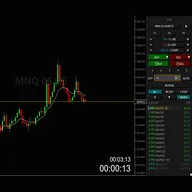
Valentin V.
Lead Quantitative Developer • Nexus Indicator • GitHub • LinkedIn
Valentin V. is the Lead Quantitative Developer at Nexus Indicator, specializing in developing high-precision tools and indicators for NinjaTrader 8. With over a decade of experience in C# and NinjaScript, he has helped hundreds of prop firm traders professionalize their execution workflows through technical discipline, systematic risk management, and automation.