Execution and Risk Management
Why Traditional Life Rules Will Blow Your Trading Account: The Cognitive Programming Trap
"The rules that bring you success in the structured world of school, careers, and society are the exact rules that will destroy your capital in the market. To survive, you must unlearn your lifetime cognitive programming."
For most retail and prop firm traders, the battle for consistency is a cycle of frustration. You learn a strategy, refine your technical setups, memorize market structure pivots, and establish strict risk management guidelines. Yet, when live capital is on the line, the same destructive behaviors repeat: you overtrade during market chop, hesitate on valid execution signals, exit winning trades prematurely, and move stop losses out of a desperate hope that the market will reverse.
When these errors occur, the standard response is to blame a lack of discipline, a weak mindset, or a flawed strategy. Traders buy more psychological books, watch motivational videos, or cycle-test new indicators, hoping to find a cure. However, this diagnosis misses the mark. The behaviors that sabotage your trading account are not the primary problem, they are merely symptoms. The root cause is much deeper, older, and completely unrelated to the market itself.
The real issue is your lifelong cognitive programming. You are attempting to play a highly unstructured, probabilistic game using a set of rules and behaviors that were built for structured, deterministic environments, such as classrooms, traditional careers, and family dynamics. You are playing the wrong game with the wrong rules. To achieve consistency, you must identify this hidden programming and build execution systems that protect your capital from your own conditioning.
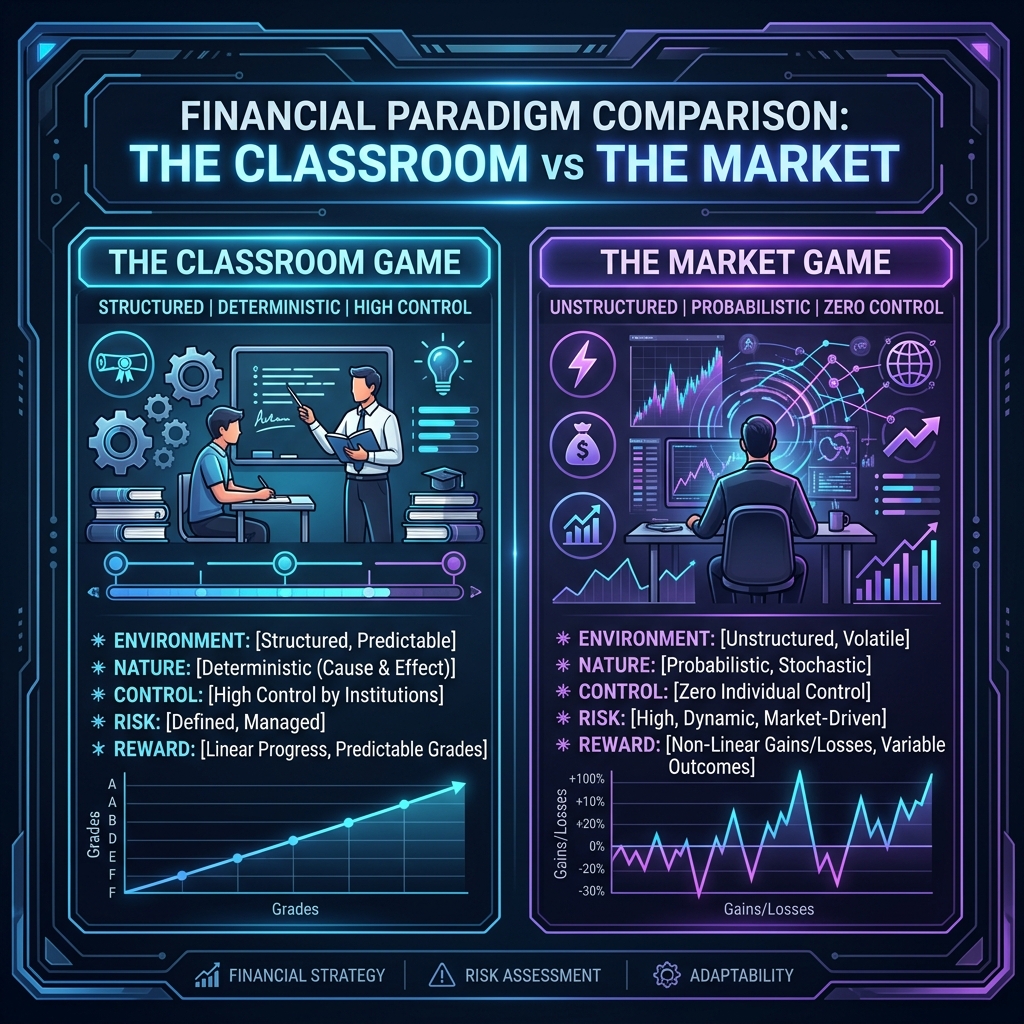
Graphic Suggestion
Type: Comparison Table
Placement: Immediately following the first H2 section, summarizing classroom rules versus market realities.
Purpose: Compares how structured rules are rewarded in life but punished in systematic trading, emphasizing the cognitive mismatch.
AI Image Prompt: A modern, high-tech financial infographic showing a side-by-side comparison of the 'Classroom Game' (structured, deterministic, high control, linear reward) versus the 'Market Game' (unstructured, probabilistic, zero control, non-linear reward). Dark mode design, neon blue and violet details, sleek dashboard UI styling, clear English text.
1. The Clash of Environments: Structured Life vs. Unstructured Markets
From early childhood through adulthood, your brain is conditioned to operate in structured environments. In these environments, specific behaviors are rewarded, and others are penalized. This conditioning builds your cognitive program, the rules you use to navigate decisions, evaluate risk, and seek rewards. When you enter the financial markets, you import this programming intact, completely unaware that the market is a chaotic system that operates on an entirely different set of rules.
There are three core areas where your lifelong conditioning clashes directly with the reality of systematic execution:
A. The Illusion of Effort and Control
In almost every area of life, effort correlates directly with control and outcomes. If you want to pass a difficult exam, you study more hours. If you want to succeed in your career, you put in more effort. If you want to master a physical skill, you practice longer. Your brain is trained to believe that effort gives you control over the environment.
In trading, this correlation is completely broken. Effort does not control the market outcome. You can spend twelve hours analyzing order flow, mapping market structures, and calculating volume indicators. You can execute a trade that is technically perfect, and the trade can still result in an immediate stop-out. Conversely, you can execute a trade based on a complete whim, break every risk rule, and watch price explode in your favor. If you are not prepared for this lack of control, you will react by trying to force control, resulting in over-leveraging and revenge trading.
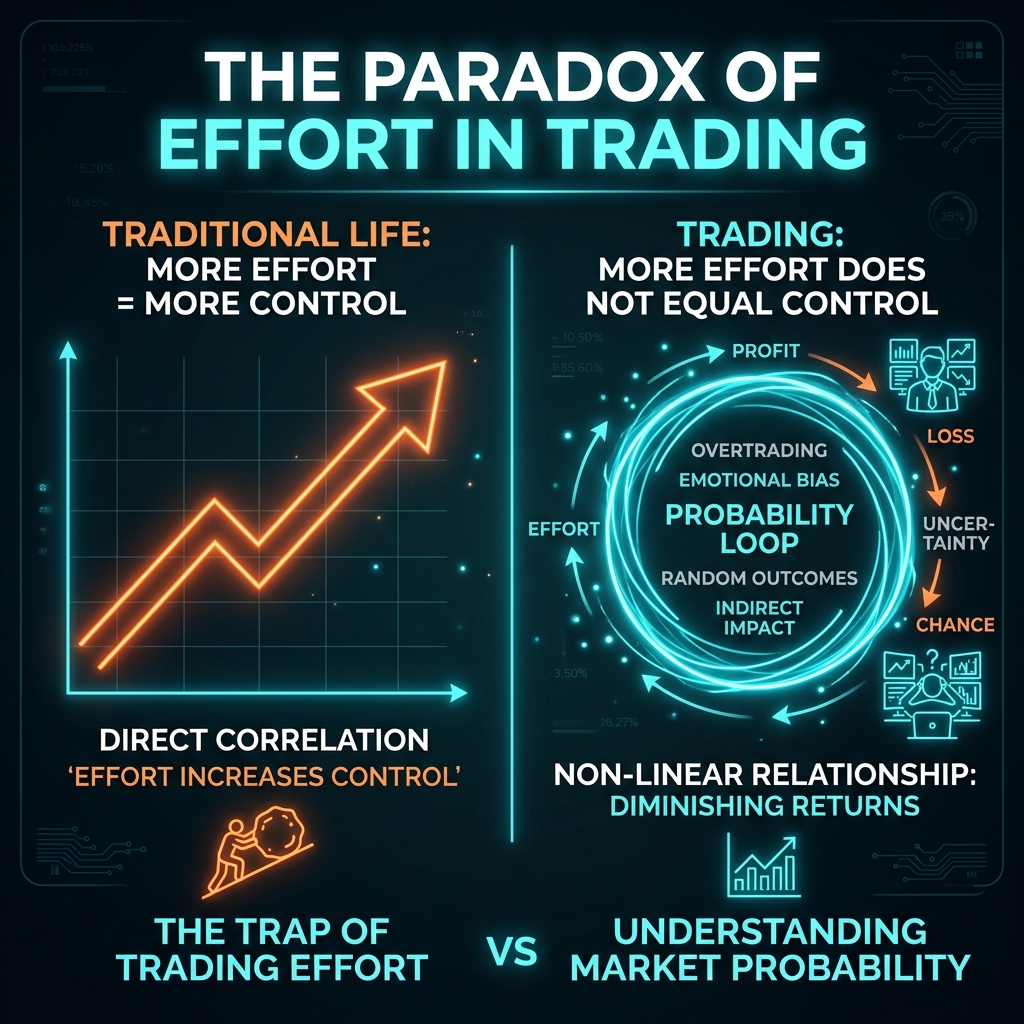
Graphic Suggestion
Type: Flowchart / Diagram
Placement: Right after the discussion on the Illusion of Effort and Control, showing the loop of forced control.
Purpose: Illustrates how trying harder in trading leads to larger losses, unlike traditional careers.
AI Image Prompt: A sleek dark-themed diagram illustrating the paradox of effort in trading. One side shows 'Traditional Life: More Effort equals More Control', depicted as a straight line rising. The other side shows 'Trading: More Effort does not equal Control', depicted as a circular probability loop. Neon cyan and orange glow, high-end finance UI style, clear English labels.
B. The Reward System of Perfectionism
Traditional education systems reward being correct. Getting a high grade means making the fewest mistakes. Making a mistake is categorized as a failure, a reflection of your preparation or capability. Being wrong is something to avoid at all costs.
In systematic execution, being wrong is a standard cost of doing business. A professional trading system with a high positive expectancy can win only 40% of the time, meaning the trader is wrong 60% of the time. In the classroom, a 40% score is a failure. In the market, if those 40% of wins are three times larger than the 60% of losses, it is a highly profitable business. If your brain is programmed to avoid being wrong, you will hesitate to enter valid setups, exit trades prematurely to avoid drawdowns, or hold losing trades indefinitely to avoid accepting a loss.
C. Scarcity and Protection of Capital
Many individuals grow up with programming centered on scarcity: the belief that money is limited, hard to acquire, and easily lost. This programming is highly useful for household budgeting, but it is destructive when executing a trading system.
If you view money through a lens of scarcity, every open trade feels like a personal threat rather than a statistical position. You will cut winning trades short because you do not trust that price will reach your target. You will treat the floating profit on your dashboard as money that is yours, rather than capital that belongs to the market until the trade is closed. This scarcity response prevents your system math from playing out, keeping your average win size too small to recover from your standard losses.
2. Tracing the Symptoms: Re-framing Your Execution Errors
To break the cycle of failure, you must stop viewing your execution mistakes as isolated discipline issues. They are symptoms of your hidden programming. If you attempt to fix the symptom without addressing the root cause, your brain will simply express the pattern in a different way. If you force yourself to stop overtrading, you might start hesitating on valid setups. If you stop exiting wins early, you might start moving your stop losses. The symptom changes, but the root pattern remains active.
Let's map the common execution symptoms back to their cognitive programming roots:
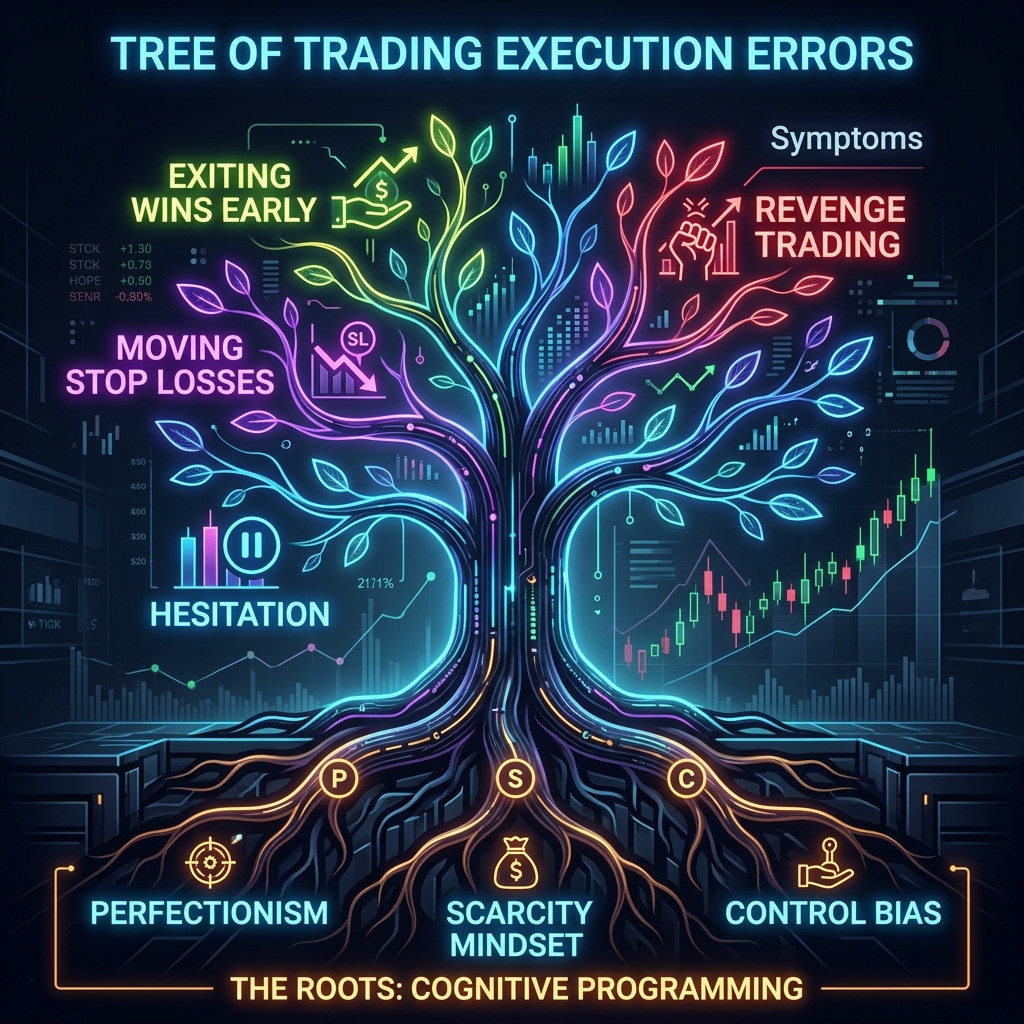
Graphic Suggestion
Type: Infographic / Tree Diagram
Placement: Immediately before the symptom analysis section, showing the connection between roots and branches.
Purpose: Visualizes how different execution errors are branches of the same cognitive roots, helping traders understand the systemic nature of tilt.
AI Image Prompt: A premium dark-themed visual graphic representing a tree of trading execution errors. The roots are labeled with cognitive programming: 'Perfectionism', 'Scarcity Mindset', and 'Control Bias'. The branches represent resulting symptoms: 'Revenge Trading', 'Moving Stop Losses', 'Hesitation', and 'Exiting Wins Early'. Neon glow, dark background, technical finance vibe, clear English text.
| Execution Symptom | The Internal Dialogue | The Hidden Cognitive Root |
|---|---|---|
| Hesitating on Valid Setups | "I need one more confirmation indicator. What if this trade is a loser?" | Perfectionism: Needing to be correct to feel valuable. Fear of making a mistake. |
| Cutting Winners Prematurely | "I need to lock this profit in before the market takes it back. A bird in the hand." | Scarcity Mindset: Viewing money as limited and highly volatile, rather than a tool of probability. |
| Moving Stops / Adding to Losses | "If I give it more room, it will turn around. I can't let this hit my stop." | Control Bias & Perfectionism: Refusing to accept being wrong, treating a loss as a personal failure. |
| Revenge Trading | "The market stole that money. I need to make it back right now." | Control Bias: Believing effort and aggression can force the market to yield profits. |
By mapping your behaviors to these roots, you realize that your trading problems are not unique. You are not lazy, stupid, or incapable of discipline. You are simply operating on a set of subconscious rules that are mismatched with the environment. If you want to change the output, you must change how you process the inputs.
Recommended Tool: Tracing these repeating patterns requires historical evidence. The Nexus Trading Journal allows you to tag trades with psychological markers and execution ratings. This turns emotional sessions into structured data, making it easy to identify whether your losses are coming from strategy variance or cognitive programming triggers.
3. The Behavioral Isolation Strategy: Enforcing Friction Before Fixing the Mind
Most trading books suggest that you must undergo a complete psychological transformation before you can become profitable. They tell you to master your mind, eliminate fear, and achieve a state of emotional detachment. While this is an excellent long-term goal, it is highly impractical for a trader who is actively executing and risking capital.
Deconditioning a lifetime of cognitive programming takes months, sometimes years. If you attempt to trade live while trying to rebuild your psychology, you will blow your account before the mental shift occurs. You cannot think your way out of an emotional reaction when price is moving rapidly against your Nasdaq position.
The solution is the Behavioral Isolation Strategy. This is a two-step process:
- Isolate the Behavior: Enforce strict, automated execution rails at the software level to stop the capital damage immediately. Do not rely on discipline, remove the decision entirely.
- Investigate the Root: Once your capital is secured behind automated guardrails, use performance data and structured journaling to investigate and deconstruct the underlying cognitive programming.
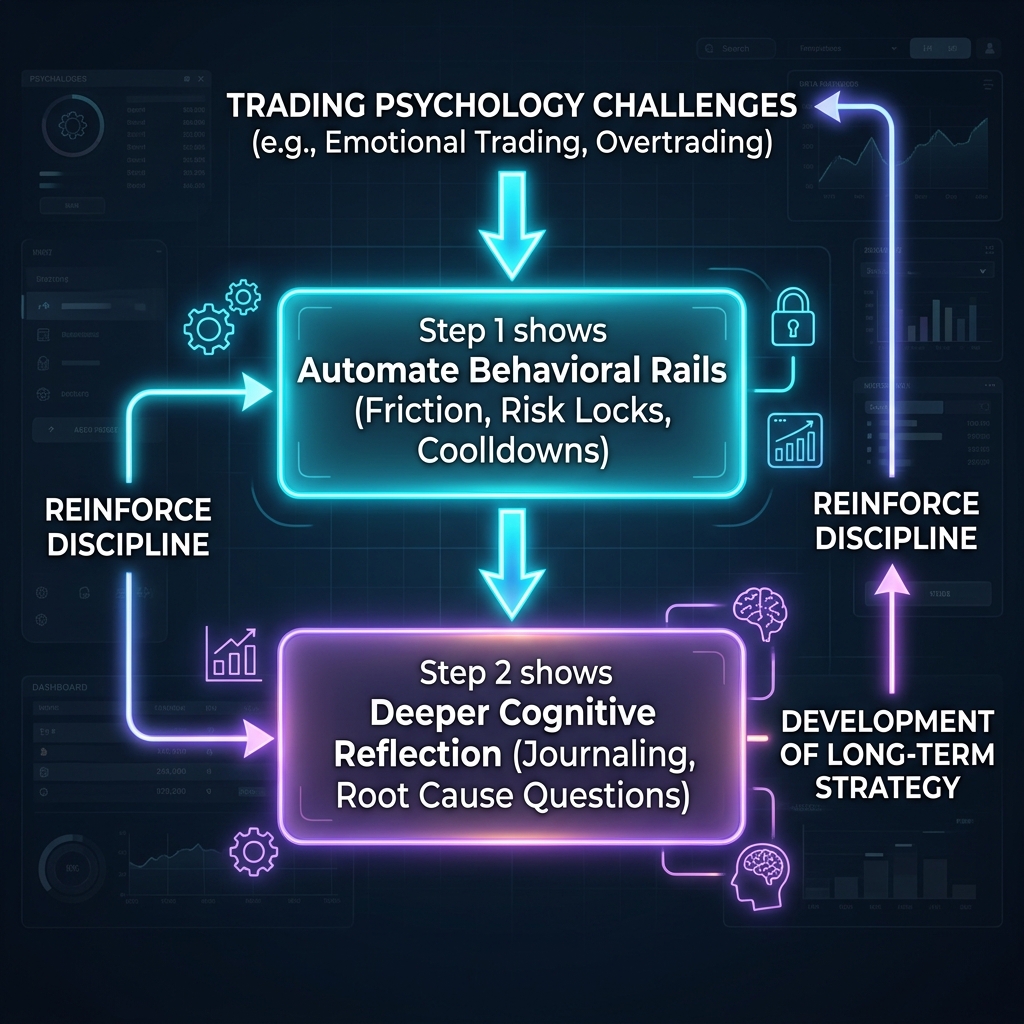
Graphic Suggestion
Type: Flowchart / Process Graphic
Placement: Within the Behavioral Isolation Strategy section, visualizing the two-step process.
Purpose: Demonstrates the logic of securing execution with software friction before performing cognitive analysis.
AI Image Prompt: A clean, modern flowchart of the Behavioral Isolation Strategy in trading. Step 1 shows 'Automate Behavioral Rails (Friction, Risk Locks, Cooldowns)' in a glowing cyan box. Step 2 shows 'Deeper Cognitive Reflection (Journaling, Root Cause Questions)' in a violet box. Sleek dashboard theme, glowing connections, high-end visual design, clear English text.
Step One: Automating Behavioral Rails (The Friction Principle)
Human beings are highly emotional creatures. Under stress, your brain shifts execution duties from the logical prefrontal cortex to the emotional amygdala. In this state, you will violate your trading plan, regardless of your discipline. The only way to prevent this is by removing your ability to make decisions when you are emotional.
You must build friction into your execution environment. Friction is the introduction of technical barriers that make it difficult or impossible to perform destructive actions. For example:
- If you revenge trade after a loss, your execution platform must lock you out, forcing a mandatory cooling-off period.
- If you move stop losses when a trade goes against you, your order entry dashboard must use automated bracket orders that cannot be adjusted once submitted.
- If you overtrade during New York chop, your platform must automatically flatten your positions and cancel pending orders at a specific time, shutting down your execution capability.
This is not about forcing yourself to feel better, it is about forcing yourself to act better. By using software to isolate and control your execution behaviors, you protect your capital and allow your trading system's expectancy to function. You stop the bleeding, which is the absolute priority of any business operator.
Recommended Tool: Implementing automated friction requires an execution terminal with administrative risk controls. Nexus Chart Trader integrates directly into NinjaTrader 8 to enforce these exact behavioral rails. Features like *Tamper-Proof Daily Risk Locks* and *Global Loss Cooldowns* act as your digital risk manager, securing the terminal when your emotional limits are breached.
Step Two: Investigating the Cognitive Roots
Once your capital is secured behind automated guardrails, you can begin the work of deconstructing your cognitive programming. This requires asking yourself structured, uncomfortable questions during your post-session review. This is not about self-criticism, it is about understanding your behavioral patterns.
When reviewing your trades, ask yourself the following questions:
- On Hesitation: Where did I learn that being wrong is a reflection of my personal intelligence or value? Am I trying to use market data to achieve certainty in a game that is fundamentally probabilistic?
- On Early Exits: What does money represent to me? Did I exit this position because my strategy model indicated a reversal, or because my scarcity programming triggered a need to protect a small win?
- On Stop Loss Violations: Why did I refuse to accept this loss? What is the core fear behind being wrong on this specific trade? Where in my life did I learn that accepting a mistake is worse than suffering a catastrophic consequence?
- On Revenge Trading: Am I trading to extract capital from the market, or am I seeking control to soothe an emotional reaction? Am I treating the market as a classroom where I must prove my capability?
By writing down these observations and linking them to your journal metrics, you bring your hidden programming into your conscious awareness. Over time, the emotional charge of these triggers diminishes, and execution shifts from a personal threat to a routine business operation.
4. Restructuring Your Execution: Willpower vs. Infrastructure
The primary reason traders remain stuck in the evaluation cycle for years is the belief in the "discipline myth." They believe that if they just try harder, have more motivation, or display more discipline, they will succeed. This is a false premise.
Willpower is a finite cognitive resource. Every decision you make, every chart you analyze, and every emotional reaction you suppress drains your willpower. Under market pressure, this reserve eventually depletes, and your subconscious programming takes over. If your strategy relies on willpower to protect your capital, it is structurally flawed.
Consistent traders do not rely on willpower. They build **infrastructure**. They design an execution environment that supports systematic decision-making and automates risk control. They treat their trading platform as a business operating system, not a game of emotional discipline.
Restructuring your execution infrastructure involves three core changes:
- Dynamic Volatility Sizing: Eliminate emotional lot selection. Calculate your position sizing dynamically based on market volatility and stop loss distance, keeping your dollar risk constant across every setup. Use tools like the *Nexus Tick ATR* to convert price volatility into exact tick values.
- Multi-Account Synchronization: If you scale your trading operations across multiple prop firm accounts, do not attempt to manage them manually. Use trade copying software like *Nexus Copier* to synchronize execution. This eliminates the execution lag and cognitive load of managing multiple terminals.
- Pre-Market Data Preparation: Establish a routine that prepares your mind for probabilities before the session opens. Use historical market tools like the *Nexus Data Downloader* to backtest your setups in market replay. This builds statistical confidence, reducing the urge to seek endless confirmations during live execution.
Tools That Can Help You Apply These Concepts
Implementing these structural changes requires specialized trading tools that convert abstract psychology concepts into automated execution rails. Nexus Indicator provides a suite of professional-grade tools for NinjaTrader 8 designed to support systematic risk management:
- Nexus Chart Trader: The ultimate risk execution dashboard. It features *Tamper-Proof Daily Risk Locks* that persist across NinjaTrader restarts, preventing revenge trading. The *Profit Protector System* automatically secures floating profits, and the *Global Loss Cooldown* enforces a mandatory delay after losses to prevent emotional re-entry.
- Nexus Trading Journal: A comprehensive performance database. It allows you to track and analyze your execution patterns, tag emotional errors, and monitor your equity curve, transforming abstract feelings into quantitative data.
- Nexus Copier (Free & Pro): Synchronizes your trades across up to 3 follower accounts (free version) or unlimited accounts (pro version), reducing the cognitive overhead of managing multiple funded accounts.
- Nexus Data Downloader: Fetches historical market data for deep backtesting and market replay sessions, helping you build statistical trust in your strategy and overcome hesitation.
Conclusion: Operating Like a Business
The transition from a failing trader to a consistent professional is not a matter of finding a new indicator or acquiring willpower. It is a matter of changing your operating environment. You must recognize that the cognitive programming that served you well in other areas of life is a structural disadvantage in the financial markets.
By implementing the Behavioral Isolation Strategy, securing your capital behind automated risk systems, and utilizing data-driven tools to analyze your execution patterns, you remove emotion from the equation. You transition from an emotional speculator seeking control to a systematic operator executing a business model. Stop trying to control the market, and start controlling your infrastructure.
Frequently Asked Questions
What is cognitive programming in trading and why does it cause failure?
Cognitive programming refers to the subconscious mental rules, beliefs, and behavioral loops you developed in structured environments like school, traditional careers, and family dynamics. It causes failure in trading because the market is an unstructured, probabilistic environment. Rules like "trying harder gives control" or "being wrong is a failure" clash directly with market realities, leading to revenge trading and hesitation.
How does the Behavioral Isolation Strategy work?
The Behavioral Isolation Strategy is a two-step approach to resolving trading execution errors. Instead of attempting to fix deep psychological issues while risking capital, you first isolate the behaviors by implementing automated technical barriers (such as daily risk locks and loss cooldowns) at the software level. This protects your capital. Once the damage is stopped, you investigate the cognitive roots of your actions through structured journaling and performance analysis.
Why does willpower fail to prevent overtrading and tilt?
Willpower is a finite cognitive resource that depletes as you analyze charts, manage trades, and suppress emotions. When market volatility increases or you experience consecutive losses, your cognitive load increases, depleting your willpower. At this point, your subconscious programming overrides your logical intentions, leading to impulsive actions like overtrading or removing stops.
What is the difference between paper discipline and infrastructure?
Paper discipline is the reliance on mental rules and willpower to manage risk (e.g., telling yourself you will walk away after two losses). Infrastructure is the implementation of physical, software-based guardrails (e.g., using Nexus Chart Trader to automatically lock your terminal after a daily loss limit is hit). Infrastructure removes human decision-making during highly emotional states, ensuring your risk rules are enforced.
How can journaling help identify my cognitive programming triggers?
Journaling using tools like the Nexus Trading Journal allows you to record not just entry and exit prices, but also your mental states, execution ratings, and psychological tags. Over a large sample of trades, this quantitative data highlights patterns, showing you exactly which setups, drawdowns, or market conditions trigger behaviors like early exits or stop-loss adjustments.
Master Your Execution
Call to action description goes here. Direct the user to a specific Nexus tool.
Upgrade Your Workflow
Valentin V.
Lead Quantitative Developer • Nexus Indicator • GitHub • LinkedIn
Valentin V. is the Lead Quantitative Developer at Nexus Indicator, specializing in developing high-precision tools and indicators for NinjaTrader 8. With over a decade of experience in C# and NinjaScript, he has helped hundreds of prop firm traders professionalize their execution workflows through technical discipline, systematic risk management, and automation.