Execution and Risk Management
Why Most Traders Blow Up Before They Can Build Wealth: The Critical Path to Capital Preservation
"Successful wealth building in financial markets is not about predicting the next volatile outlier. It is about constructing a robust infrastructure that survives short term variance, letting you exploit a mathematical edge over time."
The transition from a speculative retail account to structured wealth generation is the most significant hurdle any trader faces. Despite a massive democratization of trading technology, professional educational resources, and global market access, the industry failure rate remains stubbornly stuck. Why do the vast majority of active traders blow up their accounts before they can ever compound meaningful wealth?
The answer is not a lack of technical knowledge or access to research. Today, retail participants possess analytical capabilities that once belonged exclusively to multi-billion-dollar institutions. The failure lies in a fundamental misunderstanding of risk, expectancy, and structural execution. To succeed, traders must step out of the casino of leveraged speculation and establish a disciplined, system-oriented investment model built to survive the laws of probability.
Key Takeaway
Sustainable wealth generation is a function of systematic process execution and capital preservation, not prediction accuracy. Avoiding catastrophic, leverage-induced errors is the ultimate trading edge.
1. The Church and the Casino: Defining Your Market Objective
The stock market operates as a dual environment: a church with a casino attached. There are market participants who live in the church, and there are those who live in the casino, both playing the same underlying game but with completely different mechanics and outcomes.
The church represents the patient, systematic compounding of capital. In this arena, you buy high-quality assets without excessive leverage, allowing the steady appreciation of global economic growth to work in your favor. It is relatively safe, structurally boring, and mathematically reliable over long-term horizons. In contrast, the casino is the space of high-leverage day trading, short-term options, and chasing speculative outliers. It promises rapid wealth but is mathematically structured to extract capital from the undisciplined.
The greatest psychological trap in trading is winning early in the casino. When a beginner takes highly leveraged, volatile positions and experiences a massive payout, it registers as a false validation of skill. This initial success is often the worst thing that can happen to a trader. It encourages them to continue using high-volatility methods, ensuring that sooner or later, a normal sequence of market variance will completely wipe out their capital.
"The biggest trading edge often comes from avoiding catastrophic mistakes, not chasing outlier returns."

2. The Myth of Institutional Superiority and the Rise of Benchmark Hugging
Retail traders often struggle with an 'us versus them' mentality, believing that large institutional skyscrapers possess a massive informational or analytical advantage. They imagine institutional desks executing sophisticated, high-alpha strategies that are impossible for retail players to replicate. This is largely a myth.
In reality, the primary goal of most traditional institutional asset managers is not the maximization of absolute returns (alpha). Instead, their incentives are built around protecting their assets under management (AUM) and the steady management fees derived from them. For a multi-billion-dollar fund, underperforming the benchmark index is business suicide. If the index is up 100% and they are up only 70%, clients will withdraw their capital. However, attempting to generate massive alpha risks significant underperformance, which would destroy their business model.
Consequently, institutions are structurally incentivized to be mediocre. They engage in 'benchmark hugging' - staying quietly in the middle of the pack, tracking the index with minor adjustments, and collecting their fees. The majority of their employees work in compliance, risk, and marketing, not alpha generation. This institutional rigidity leaves a massive vacuum that disciplined retail operators can exploit.
| Dimension | Institutional Managers | Systematic Retail Operators |
|---|---|---|
| Primary Objective | Fee preservation & benchmark tracking | Absolute return & wealth compounding |
| Risk Profile | Conservative, benchmark-correlated | Absolute risk targets, non-correlated |
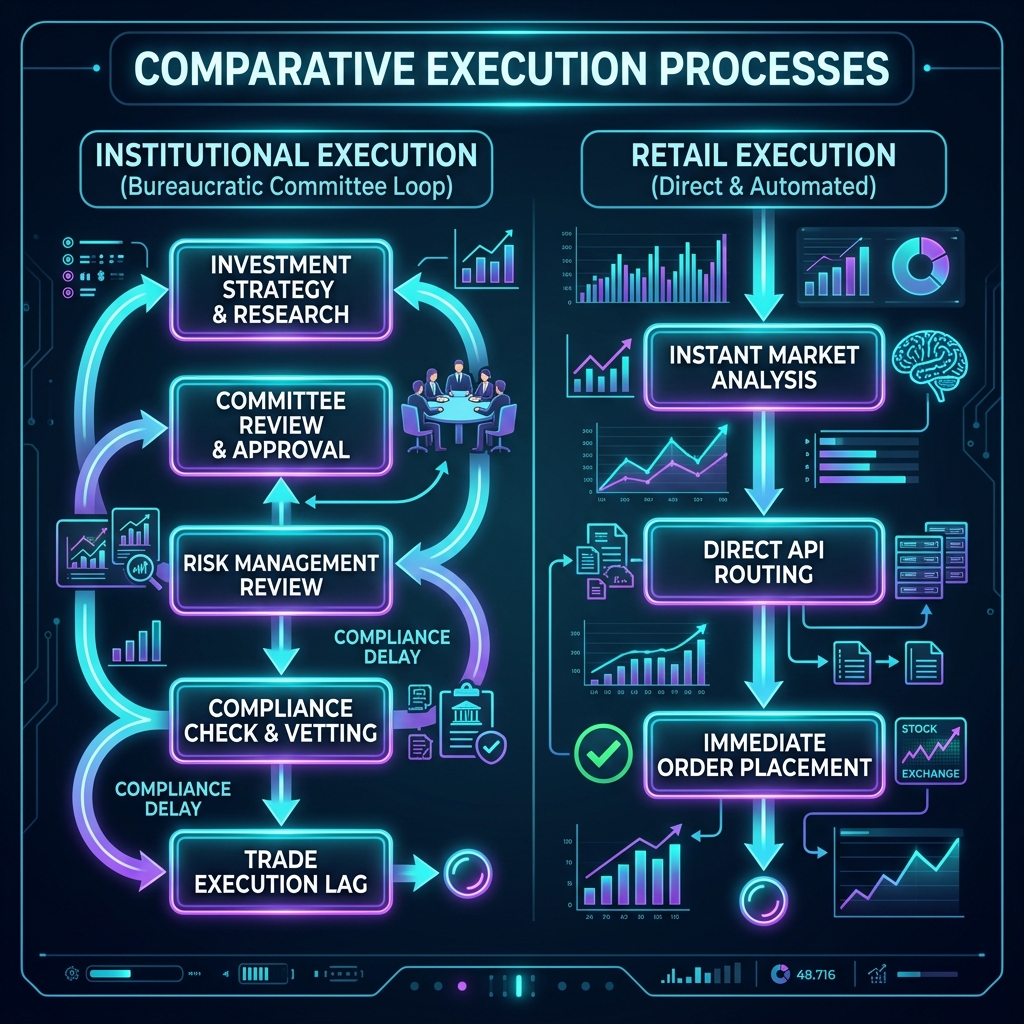
| Execution Speed | Slow, delayed by committee approvals | Instant, automated execution rails |
| Asset Universe | Large caps, high-liquidity names only | Small caps, micro-futures, exotic assets |
Key Takeaway
While institutions are constrained by size, committees, and compliance structures, retail operators possess absolute freedom. You do not need to outperform the market every single day; you only need to execute your edge with mechanical discipline.
3. The Real-World Science of Technical Analysis
Many retail education systems focus on subjective pattern recognition: treating chart reading like a search for hidden geometric shapes. Traders spend hours looking for head-and-shoulders patterns, flags, or double bottoms, believing these visual indicators predict future price. In modern electronic markets, these classic chart patterns are mostly a myth.
Large algorithms do not place multi-million-dollar orders based on visual support lines or chart shapes. Instead, technical analysis must be distilled down to its scientifically measurable components. Price action can be broken down into three primary dimensions:
- Trend: The overall directional flow of money over a specified time horizon.
- Volatility: The rate of price variance and expansion around the mean.
- Deviation: The distance price has traveled from its key average values, signaling mean-reversion boundaries.
One of the few academically validated anomalies in technical analysis is the momentum factor. Momentum describes the tendency of assets that have outperformed over the past year to continue outperforming in the near term. This momentum effect creates a consistent alpha, but implementing it requires managing the transactional churn of rebalancing and avoiding the sudden trend reversals that wipe out momentum portfolios. Conversely, metrics like the Commitment of Traders (COT) report are often lagging indicators; they tell you what the trend followers are already doing, rather than predicting new market directions.
How To Apply This
Instead of manually looking at static charts, construct automated scanners to measure these three core variables. Utilize indicators that dynamically adjust to price volatility rather than relying on fixed input settings. For example, sizing exits and stop-loss levels based on a multiple of volatility prevents your orders from being hit prematurely during sudden market expansions.
Recommended Tool
Nexus Tick ATR
The Challenge: Fixed target sizes (e.g., a 10-tick stop loss) do not account for shifts in market volatility, resulting in premature stop-outs when the market expands or missed profit targets when the market contracts.
How it Helps: The Nexus Tick ATR automatically measures real-time tick volatility on NinjaTrader 8, allowing you to scale your trade parameters to current market conditions.
Download Free Tool4. The Leverage Trap: The Number One Enemy of Retail Survival
The primary reason most traders blow up their accounts is the misuse of leverage. When a trader opens a small account with $500 or $1,000, they are immediately tempted by the high leverage ratios offered by brokers. This leverage turns a retail participant into a temporary market player, but it also increases their probability of ruin to near certainty.
In any trading system, consecutive losses are a statistical certainty. Even a highly profitable strategy with a 60% win rate will eventually experience streaks of five, seven, or ten consecutive losses over a large sample size of trades. Under normal, unleveraged conditions, this variance is simply a minor drawdown on the equity curve. However, when using high leverage, a single sequence of three or four consecutive losses will completely wipe out the account equity before the long-term mathematical edge has a chance to play out.
"Leverage magnifies short term market variance, transforming standard mathematical drawdowns into permanent capital ruin."
Wealth building requires you to treat capital as your primary inventory. If you lose your inventory, your business is closed. Professional risk management dictates that you calculate risk based on your overall capital limits, ensuring that no single trade or sequence of trades can cause catastrophic damage to your portfolio. This means avoiding the emotional trap of revenge trading and utilizing automated execution infrastructure to enforce risk rules when willpower fails.
Common Pitfall: Willpower-Based Risk
Relying on mental discipline to close losing trades or walk away after hitting a daily loss limit. When emotional stress increases, cognitive capacity depletes, leading to ignored stops and blown accounts.
Professional Routine: Automated Guardrails
Implementing hard, platform-enforced locks that automatically restrict order submission once risk parameters are breached. This completely removes human emotion from risk enforcement.
Recommended Tool
Nexus Chart Trader
The Challenge: suppressive emotional states can lead to revenge trading and the manual overriding of risk rules during a losing session.
How it Helps: Nexus Chart Trader provides tamper-proof daily risk locks that persist across platform restarts, enforcing a mandatory global loss cooldown and preventing emotional overtrading.
Explore Nexus Chart Trader5. Play to Your Strengths: The Real Retail Advantages
To succeed, retail traders must stop trying to compete in arenas where institutions hold a structural monopoly. Do not attempt to compete with high-frequency algorithms in microsecond latency execution. Instead, identify and leverage the unique advantages that retail operators hold over institutional players.
First, retail traders possess size agility. Because a retail operator manages relatively small amounts of capital, they can easily enter and exit positions without causing market impact. An institution managing billions of dollars cannot buy or sell a mid-cap stock without pushing the price against themselves. Retail operators can target smaller, under-researched stocks, micro-futures, and highly liquid derivative assets, capturing inefficiencies that are too small for institutional participation.
Second, retail traders have zero bureaucratic drag. An institutional manager must get approval from investment committees, risk departments, and compliance teams before placing a non-standard trade. This process can take days, completely destroying their ability to capture immediate market opportunities. As a retail operator, you can modify your risk exposure, reallocate assets, and execute strategies instantly, adapting to changing market environments in real time.
Key Takeaway
The combination of absolute execution freedom and size agility makes the retail operator a highly lethal participant in the market. The goal is to build an infrastructure that supports this agility while automating the risk management that keeps you alive.
How To Apply This
If you are managing multiple funded accounts to scale your capital size, do not attempt to execute trades manually across different terminals. Replicating orders manually introduces execution lag and increases the risk of error. Implement a professional copier system to route trades instantly from your master terminal, maintaining structural alignment across your entire capital base.
Recommended Tool
Nexus Copier
The Challenge: Managing risk across multiple funded accounts manually is highly inefficient, leading to execution discrepancies, slippage, and violations of consistency rules.
How it Helps: Nexus Copier replicates your trades from a master NinjaTrader 8 terminal to follower accounts instantly with a 500ms reconcile loop, ensuring identical parameters across all accounts.
Get Nexus Copier Free6. Building a Professional Wealth-Building Portfolio
True diversification is the only free lunch in investing. However, many retail traders confuse allocation exposure with diversification. Placing your entire capital base into gold and silver is not diversification; both assets are highly correlated precious metals. Similarly, holding Bitcoin and Ethereum is simply concentration in the digital asset risk factor.
A professional wealth-building portfolio must utilize non-correlated assets that respond to different macroeconomic drivers. This involves allocating capital across equities, fixed-income duration, real-world reserve assets like gold, and digital-world reserve assets like Bitcoin. Gold operates as the ultimate hedge against fiat currency debasement and real-world geopolitical risk, following nominal global GDP growth. Bitcoin, as the reserve asset of the digital economy, behaves as a high-velocity volatility vehicle, scaling with the expansion of digital commerce and technological adoption.
Instead of manually adjusting your allocations based on predictions, use a volatility-weighted framework. Under this model, capital allocations are dynamically balanced based on the inverse volatility of the assets. When an asset experiences high volatility, its weight in the portfolio is reduced; when it becomes calm, its weight is increased. This systemic approach allows you to capture the growth of highly volatile assets like Bitcoin while anchoring the portfolio with stable assets like gold, creating a robust, non-correlated compounding engine.
Key Takeaway
True diversification requires assets that move independently of one another. Gold and Bitcoin serve as excellent counterbalances, providing a volatility-diversified store of value for the digital age.
Tools That Can Help You Apply These Concepts
Transitioning from a speculative speculator to a systematic operator requires the right execution infrastructure. Nexus Indicator provides a suite of professional tools for NinjaTrader 8 to help you manage risk, scale capital, and analyze performance:
- Nexus Chart Trader: Protects your account from leverage-induced ruin with automated daily risk locks, profit protectors, and global loss cooldowns.
- Nexus Copier: Scales your execution instantly across multiple funded accounts without lag or replication discrepancies.
- Nexus Trading Journal: Eliminates emotional analysis by tracking and quantitative monitoring of your expectancy and execution patterns.
- Nexus Data Downloader: Enables historical testing and market replay, building statistical confidence in your execution parameters.
Frequently Asked Questions
What is the difference between the church and the casino in trading?
The church represents the long term, patient, and compounding approach to investing in high quality assets without excessive leverage. The casino represents the short term, highly leveraged, and speculative trading environment where participants chase rapid gains but face a high probability of total capital ruin.
Why do institutions focus on mediocrity rather than maximizing alpha?
Institutions prioritize protecting their assets under management (AUM) and management fees. Underperforming the benchmark index is business suicide, whereas trying to significantly outperform introduces the risk of catastrophic underperformance. Therefore, they choose to stay quietly in the middle, tracking the index.
What are the three measurable factors of price action in technical analysis?
Instead of subjective geometric chart patterns, professional technical analysis focuses on trend (overall direction), volatility (price variance), and deviation from the trend (mean reversion boundaries). These three factors can be quantitatively measured and coded into systematic execution rules.
Why is leverage considered the primary enemy of wealth building?
Leverage magnifies short term market variance. If a trader uses excessive leverage, even a normal, temporary sequence of consecutive losses will completely wipe out the account equity before the positive mathematical expectancy of their strategy has a chance to play out.
How does multi-account trade copying help scale retail trading?
Multi-account trade copying allows a trader to distribute their risk across multiple funded accounts simultaneously. By replicating trades automatically from a master terminal to follower accounts, they scale their total capital size without increasing the risk of ruin on any single account.
Master Your Execution
Build institutional-grade risk management into your terminal. Get started with Nexus Chart Trader today.
Upgrade Your Workflow
Valentin V.
Lead Quantitative Developer • Nexus Indicator • GitHub • LinkedIn
Valentin V. is the Lead Quantitative Developer at Nexus Indicator, specializing in developing high-precision tools and indicators for NinjaTrader 8. With over a decade of experience in C# and NinjaScript, he has helped hundreds of prop firm traders professionalize their execution workflows through technical discipline, systematic risk management, and automation.