
Market Structure & Execution

Prior Day Levels in Futures Trading: The 2026 VWAP and Pivot Point Playbook for NinjaTrader 8

March 28, 2026 40 Min Read

"Most traders open NinjaTrader 8, glance at the chart, and wait for 'something to happen.' Elite traders open NinjaTrader 8, map every institutional reference level from the prior session, and patiently execute when price reaches their pre-planned zones. Prior day levels are the difference between reactive gambling and structured execution."

Every morning at 9:30 AM Eastern, the U.S. equity futures market opens with price already carrying the memory of yesterday. The institutional algorithms running inside the major clearing firms at the CME Group are programmed to react at specific reference points: the prior day's high and low, the previous session's volume-weighted average price, and a set of mathematically-derived pivot levels. These are not just technical indicators — they are coordination signals between large players.

When you trade prior day levels in NinjaTrader 8 with a structured daily reference map, you are aligning your execution with institutional memory rather than fighting it. This guide will walk you through every layer of the prior day levels framework — from the basic OHLC hierarchy to VWAP band positioning and pivot type selection — and show you exactly how to build a pre-session playbook that removes guesswork from every trade you take.

What Are Prior Day Levels? (The Definitive Answer)

Prior day levels are the key price reference points inherited from the previous trading session. In futures markets, the most critical prior day levels are:

  • Prior Day High (PDH): The highest price traded in the previous session. Acts as the primary resistance reference going into a new day.
  • Prior Day Low (PDL): The lowest price traded in the previous session. Acts as the primary support reference.
  • Prior Day Close: Where the session settled. Institutions use this as a directional bias anchor — price above the prior close is bullish context, below is bearish.
  • Prior Day Open: Where the session began. Less common as a reference but useful when combined with the close to assess what the prior day's net sentiment was.
  • Prior Day Midpoint: (Prior Day High + Prior Day Low) / 2. An underrated level that marks the exact center of the prior session's range, often acting as a pivot between up and down bias zones.
  • Prior Day VWAP: The volume-weighted average price of the prior session. Unlike the close, VWAP incorporates where the majority of volume actually transacted, giving a more accurate picture of where institutional participants were positioned.

These levels are static for the duration of the new session — they don't move. That is precisely their power. Unlike dynamic indicators that twist with every new tick, prior day levels provide a fixed grid that allows you to plan specific entry zones, stop placements, and targets before the market opens.

Why Institutions React at Prior Day Levels

Large order flows are partially driven by rules-based execution logic. A systematic fund managing billions of dollars in ES futures cannot simply "decide" when to buy or sell — it must execute based on quantifiable conditions. Prior day levels are one of the most common inputs in these systems. When you observe heavy volume at PDH or PDL and a sharp rejection, you are seeing institutional rules triggering in real-time. Understanding this removes the illusion that these reactions are random.

The Prior Day Levels Hierarchy: How to Prioritize When They Stack

In active futures sessions, it is common for multiple prior day levels to be clustered within a narrow price band — especially on low-range days where the PDH, prior day VWAP, and the S1 pivot all compact within 4-6 ticks. Knowing which levels to prioritize prevents analysis paralysis and keeps your execution framework clean.

Tier 1: Prior Day High and Prior Day Low

PDH and PDL are always your anchor levels. They represent the absolute extremes of institutional consensus from the previous session. Every algorithmic system that monitors prior-day data uses these as primary triggers. A break above PDH with volume confirmation often initiates a breakout sequence; a rejection at PDH with a volume spike is one of the cleanest reversal setups in futures trading.

When mapping your daily chart in NinjaTrader 8, PDH and PDL are the first levels you draw. Everything else is secondary context. In our detailed breakdown of how these levels interact with market structure, see our guide to Market Structure Mapping with Nexus Levels.

Tier 2: Prior Day VWAP

Prior Day VWAP (pdVWAP) is the level where the majority of the prior session's volume was executed. It is a balance point — the price at which buyers and sellers were most evenly matched yesterday. Today, price will often seek to test this level as part of the natural mean-reversion tendencies built into most futures instruments.

If price opens above pdVWAP, the session begins in a technically bullish posture — one where late shorts from yesterday are underwater and may be forced to cover. If price opens below pdVWAP, the opposite applies. This directional context is your session bias until the live VWAP establishes its own trend.

Tier 3: Prior Day Close and Midpoint

The prior close serves as a psychological threshold and often acts as a magnet during the first 30 minutes of the session if there is an overnight gap. Price that gaps above the prior close will frequently retest it before committing to a directional move — this is the "gap fill behavior" that creates some of the most reliable morning setups in ES and NQ futures.

The prior day midpoint deserves more respect than most retail traders give it. Market profile theory identifies the Point of Control (POC) — the price with the most volume — but the midpoint approximates the range center without requiring a full volume profile tool. When price is consolidating between PDH and PDL, the midpoint often acts as the rotational center, creating excellent short-term scalp opportunities in both directions.

Tier 4: Pivot Points

Pivot points are derived mathematically from the prior day's OHLC data. They are secondary to the actual OHLC levels because they are calculations rather than real traded prices, but their widespread use creates self-fulfilling reactions that make them remarkably reliable in active markets.

VWAP and VWAP Bands: Mean Reversion vs Trend Continuation

The live session VWAP — separate from prior day VWAP — is arguably the most important intraday reference in modern futures trading. NinjaTrader 8 calculates VWAP natively, and Nexus Prior Day Levels supplements this by automatically plotting the prior day's completed VWAP alongside ±1 standard deviation VWAP bands.

Understanding the ±1 Standard Deviation Bands

VWAP standard deviation bands are calculated by measuring how far price has deviated from the VWAP anchor over the course of the session. The ±1 SD bands represent the range where approximately 68% of all volume has been transacted. In practice, these bands function as dynamic support and resistance zones with a mean-reversion bias.

The institutional usage is straightforward: execution algorithms that benchmarked against VWAP will begin reducing position size or closing trades when price moves significantly beyond the ±1 SD level. This creates a natural gravitational pull back toward VWAP after extreme moves, which experienced traders exploit by fading extensions at the band extremes during low-momentum sessions.

When Mean Reversion Fails: The Trend Continuation Signal

Not every VWAP band touch is a fade opportunity. In strong trending sessions — particularly when the macro catalyst (CPI, FOMC, NFP) is still fresh — price can spend extended periods pinned against or beyond the +1 SD or -1 SD band. This is a trend continuation signal, not a mean-reversion opportunity.

The rule we apply in practice: on high-impact event days (check the Federal Reserve FOMC calendar for scheduled events), treat VWAP band breaks as breakout entries. On standard low-event days, treat the bands as reversal zones. This distinction alone eliminates a large percentage of the "wrong direction fades" that plague new futures traders.

VWAP Band Rule of Thumb

Normal session: Price at ±1 SD VWAP = potential fade zone. Look for rejection candlesticks before entering. High-impact event day: Price at ±1 SD VWAP = potential breakout continuation. Wait for the band to be exceeded by at least 2-3 ticks and hold before entering in the direction of the move. Never assume mean-reversion on event days.

Pivot Point Types: Which Works Best for NinjaTrader 8 Futures?

Nexus Prior Day Levels supports six pivot point calculation types: Traditional, Fibonacci, Woodie, Classic, Camarilla, and DeMark. While all are mathematically valid, they serve different trading styles and session contexts. Here is how to select the right type for your approach.

Traditional Pivot Points

Traditional pivots are calculated as: P = (Prior High + Prior Low + Prior Close) / 3. The support and resistance levels radiate symmetrically from P. They are the most widely referenced pivot type in institutional and retail settings, which is precisely why they work — the more participants watching a level, the more likely it produces a reaction.

For the majority of NinjaTrader 8 traders, traditional pivots should be the baseline. Display P, R1, S1, R2, and S2. This gives you five clean reference points that cover most intraday ranges without cluttering the chart with excessive lines.

Camarilla Pivot Points

Camarilla pivots generate tighter levels that cluster closer to the prior close. They are specifically designed for intraday scalping with a mean-reversion bias. The Camarilla L3 and H3 levels are particularly effective as the "edge of the normal range" — breaks above H4 or below L4 are statistically significant breakout signals in Camarilla methodology.

If you scalp the open or trade the first 30 minutes of the regular session, Camarilla pivots are worth studying. Their narrow spacing reduces your target size but also tightens stop placements, which is beneficial for prop firm risk management. See our detailed work on this topic in the Prop Firm Daily Risk Limits guide.

Fibonacci Pivot Points

Fibonacci pivots replace the fixed R1/S1, R2/S2 multipliers with Fibonacci ratios (0.382, 0.618, 1.000, 1.618). This creates non-uniform spacing that aligns with Fibonacci clusters found in Elliott Wave analysis. These are most effective when you are already working within a clearly defined larger-timeframe wave structure and want pivot support/resistance to confirm wave termination zones.

Building Your Pre-Session Reference Map: A Step-by-Step Process

The pre-session reference map is a ritual, not an optional step. It takes 5-10 minutes before each session and eliminates the reactive decision-making that causes most intraday losses. Here is the exact process we use:

  1. Identify the prior day's high, low, close, and midpoint. These are your four anchor levels. Before you look at anything else, mark these in your mind.
  2. Determine overnight session context. Check where the current price is relative to PDH and PDL. Is price within the prior range, above it, or below it? This single question sets your morning bias.
  3. Mark the prior day VWAP. This is your institutional balance point. Price opening above pdVWAP = short-term bullish tilt. Price opening below pdVWAP = short-term bearish tilt.
  4. Layer in traditional pivots. Identify which pivot level aligns most closely with PDH and PDL — confluence between prior day extremes and pivot levels creates the highest-conviction trade zones.
  5. Check for overnight gap. If price has gapped above or below the prior close by more than 0.3%, mark the gap zone. The probability of a gap fill on the first rotation attempt is significant in equity index futures.
  6. Set your bias statement. Write one sentence: "Today I am looking for longs if price holds above [level] and shorts if price breaks [level]." This prevents the constant flip-flopping between long and short bias that characterizes undisciplined intraday trading.
  7. Note the economic calendar. Check Forex Factory for red-flag events. If there is a Fed speaker, CPI release, or NFP before 10:30 AM, adjust your first-hour approach accordingly — event-driven sessions break level after level without the normal mean-reversion behavior.

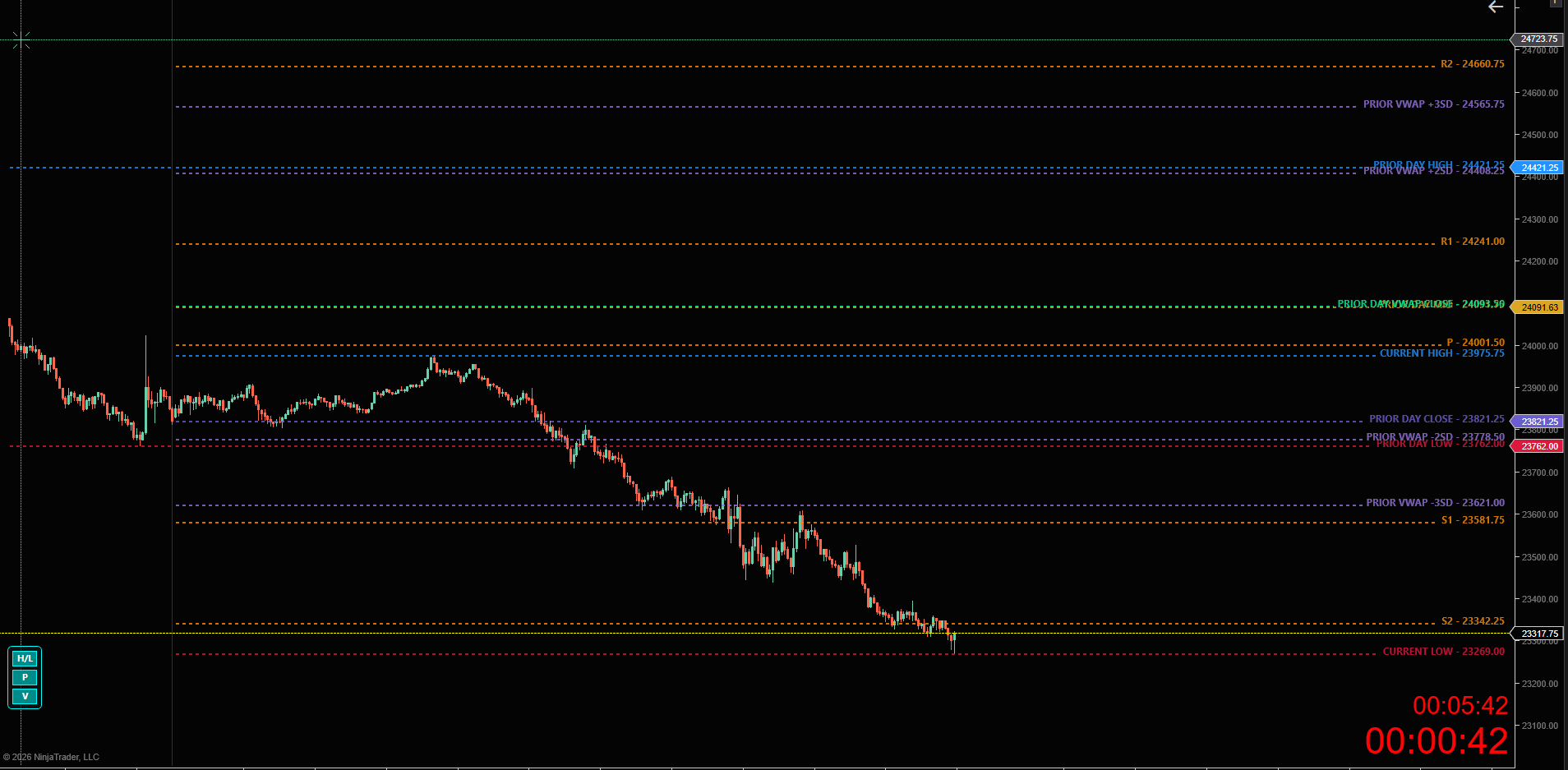
With Nexus Prior Day Levels configured in NinjaTrader 8, this entire map is drawn automatically before price even opens. The indicator plots prior day OHLC, the prior VWAP with ±1 SD bands, your selected pivot type, and optional historical days so you can see multiple sessions' worth of reference data simultaneously.

Lived Experience: How We Trade the ES Open with Prior Day Levels

We want to share a specific scenario from our own testing that illustrates the power of this approach. On a typical low-volatility Wednesday morning, ES futures opened 8 points above the prior day close. The prior day VWAP was sitting 12 points below the open price. Traditional pivot R1 was only 4 points above the open.

The pre-session reference map read clearly: ES was in bullish territory (above pdVWAP and prior close) but approaching a resistance cluster (R1 was only 4 points away). The gap created a natural gravitational pull toward the prior close, which happened to coincide with the S1 pivot — a double-confluence support zone about 14 points below the open.

Instead of chasing the immediate open momentum, we identified two scenarios:

  • Scenario A (Bull continuation): ES holds above prior close on the first pullback and reclaims R1. Entry long above R1, target R2 / pdVWAP + 1SD, stop below prior close.
  • Scenario B (Gap fill): ES fails to hold the prior close on the first test, converts it from support to resistance, and rotates toward S1/prior day midpoint. Entry short on the retest of prior close as resistance, target S1, stop above R1.

Scenario B played out. ES rejected the prior close level three times as resistance within the first 20 minutes, with the third rejection producing a volume spike (visible on Nexus Volume) that confirmed institutional selling pressure. The subsequent move to S1 was worth 11 points on ES — approximately $550 per contract — with a well-defined 4-point stop ($200 risk). This is the prop-firm-friendly risk profile that structured prior day level trading consistently produces.

We tracked the result in the Nexus Trading Journal, which confirmed the trade aligned with our best win rate context: level-based entries with sub-5-point stops at structural confluence zones. For a deeper look at how to track and measure these patterns over time, see our post on Modern Scalping and Order Flow.

Prior Day Levels and Prop Firm Compliance

There is a practical benefit to structural level trading that goes beyond pure edge: it creates a risk profile that prop firm compliance reviewers tend to approve. Firms like Apex, TopstepX, and Topstep use automated systems that flag accounts exhibiting abnormal behaviors — extremely wide stops, variable lot sizing on different trade types, or sub-five-second trade durations that suggest news-triggered speculation.

Level-based trading normalizes all of these variables. When you enter at PDH with a stop 4 ticks above and a 1.5R target, you produce:

  • A consistent stop distance (not random)
  • A consistent risk amount per trade (not variable lot chasing)
  • Trade durations in the 3-20 minute range as price reaches the target or stop
  • A clear logical narrative if the firm ever reviews your execution history

This is not about gaming the system — it is about trading in a way that is genuinely professional and risk-controlled. Prior day levels provide the natural framework for this discipline. The NinjaTrader 8 Setup Guide covers how to configure your workspace to display these levels alongside a risk management overlay from session start.

The Reactive Trader

No pre-session preparation. Trades based on feel when price looks "ready to move." Enters at random prices mid-bar with variable stop distances. Produces inconsistent risk signatures that flag compliance reviews and make positive expectancy impossible to measure.

The Structured Trader

5-minute pre-session mapping ritual. Enters only at pre-defined PDH, PDL, VWAP, or pivot confluence zones. Fixed stop placement at logical structural invalidation. Consistent risk profile, measurable edge, and clean compliance history across all prop accounts.

Common Mistakes When Using Prior Day Levels

Prior day levels are powerful, but they are not a mechanical "price touch = trade" system. Here are the most frequent errors we see traders make when incorporating them into their approach:

Mistake 1: Treating Every Level as Equally Important

Not every prior day level carries the same weight. On a day when ES has a 30-point range, the PDH and PDL are the primary levels, but the midpoint is relatively weak. On a tight 12-point range day, the midpoint becomes far more significant because price will oscillate through it repeatedly. Always weight levels based on context — range size, overnight activity, and macro calendar.

Mistake 2: Ignoring Volume Confirmation

A touch of PDH without meaningful volume is far less reliable than a touch with an above-average volume spike. Volume reveals whether institutions are actually participating at the level or whether price is just drifting through on thin liquidity. This is one area where combining prior day levels with a volume analysis tool pays immediate dividends. You can see volume spikes and participation at these levels using a tool like Nexus Volume, which plots colored volume bars and triggers spike detection when volume exceeds average by a configurable multiplier.

Mistake 3: Forcing Trades at Every Level Every Day

Some sessions simply do not have clean reactions at prior day levels. When price crushes through PDH on an FOMC day like it doesn't exist, the session is in breakout mode and the level-based framework does not apply until a new balance zone is established. Recognizing when to skip the day is as important as identifying when to trade it.

Mistake 4: Using Too Many Pivot Types Simultaneously

Displaying traditional, Fibonacci, Camarilla, Woodie, and DeMark pivots on the same chart creates so many lines that the chart becomes unreadable. Choose one primary pivot type aligned with your trading style. Add a second type only on specific setups (e.g., Camarilla for gap trading). More levels is not more analysis — it is just more noise.

Mistake 5: Ignoring the Show/Hide Toggle State After Platform Restart

A practical but critical point specific to NinjaTrader 8: indicator panel states do not always persist after a platform restart unless the indicator is designed to save them. Nexus Prior Day Levels stores your show/hide preferences for Prior Day, Pivots, and VWAP Bands in a state persistence system, so your pre-session configuration is maintained after restarting NinjaTrader without needing to reconfigure each morning.

Setting Up Nexus Prior Day Levels in NinjaTrader 8

Nexus Prior Day Levels integrates directly with NinjaTrader 8's indicator framework and deploys all of the levels discussed in this guide automatically. Here is a recommended starting configuration:

  • Prior Day Levels: Enabled. Show High, Low, Close, Open, and Midpoint. Set line width to 2 for clear visibility. Use dashed style at 80% opacity to avoid visual dominance over candlestick data.
  • Prior Day VWAP: Enabled. VWAP Bands at ±1 Standard Deviation. Main VWAP line in a distinct color (yellow or aqua works well on dark backgrounds).
  • Pivot Type: Start with Traditional. Display P, R1, S1, R2, S2 only. Toggle off R3/S3 until you need them for wide-range breakout days.
  • Historical Days: Set to 2-3 days to provide multi-session context without cluttering the chart.
  • Font Size and Labels: Enable price labels on each level so you can read the exact reference price without manually hovering on the line.

This configuration gives you a complete institutional reference map without overloading the visual field. The UI controls allow on-the-fly toggling of Prior Day, Pivots, and VWAP Bands independently — critical during fast-moving sessions when you need to reduce visual complexity quickly.

Combining Prior Day Levels with Nexus Market Structure Indicators

Prior day levels are most powerful when used in conjunction with dynamic intraday market structure tools. The highest-conviction setups occur when a prior day level coincides with a Higher Low (HL) or Lower High (LH) identified by the Nexus Levels indicator. When PDH matches a current-session Lower High, for example, you have both a static institutional memory level and a dynamic structure confirmation confirming the same rejection zone.

The Nexus Levels indicator automatically labels swing points as HH (Higher High), LL (Lower Low), HL (Higher Low), and LH (Lower High) in real-time. Pairing these live structure labels with the static prior day reference grid eliminates the ambiguity that comes from relying on either framework alone. Price reversing at PDH that coincides with a LH is a materially different trade than PDH with no structure confirmation — the former has two independent analytical frameworks pointing to the same conclusion.

Frequently Asked Questions

What are prior day levels in futures trading?

Prior day levels are the key reference prices from the previous trading session: the Prior Day High (PDH), Prior Day Low (PDL), Prior Day Close, Prior Day Open, the session midpoint, and the Prior Day VWAP. These levels act as institutional memory — algorithmic traders and market makers monitor reactions at these points, making them some of the most reliable support and resistance zones in active futures markets like ES, NQ, and CL.

How is VWAP different from a simple moving average in futures trading?

VWAP incorporates volume data, calculating the average price at which the instrument has traded throughout the session weighted by volume at each level. This makes it an institutional benchmark — large funds compare their fills against VWAP to evaluate execution quality. This institutional anchoring gives VWAP its power as a support and resistance zone during live sessions that a simple price-based moving average cannot replicate.

Which pivot point type should I use for NinjaTrader 8 day trading?

For most NinjaTrader 8 futures traders, Traditional pivots are the best baseline — they are the most widely watched, which creates the self-fulfilling reactions that make them reliable. Camarilla pivots are better for tight intraday scalping with mean-reversion bias. Fibonacci pivots work well in strong trending sessions. Start with Traditional and add a second type only when your specific strategy warrants it.

Can prior day levels improve prop firm account compliance?

Yes. Level-based trading produces consistent stop placements, consistent risk per trade, and trade durations in the normal range — all characteristics that prop firm compliance systems view favorably. Structural entries at prior day levels also provide a clear logical narrative if your account is ever manually reviewed, in contrast to mid-session momentum chases that can appear erratic in the trade history.

Does Nexus Prior Day Levels work on tick and volume charts in NinjaTrader 8?

Yes. Nexus Prior Day Levels calculates reference levels from daily session data independently and renders them across all NinjaTrader 8 chart types including tick, range bar, and volume charts. The live VWAP calculation updates on each tick, and the prior day OHLC values remain fixed as static reference lines for the session.

Conclusion: The Pre-Session Ritual That Separates Elite Traders

The prior day levels playbook is not a complex strategy requiring years of pattern recognition. It is a disciplined daily ritual: identify the institutional memory anchors from yesterday, map your session bias, determine which confluence zones have the highest probability of producing clean reactions, and execute with predetermined risk when price arrives at those zones.

What separates the traders who consistently extract value from prior day levels from those who dismiss them is patience. The levels only produce their best setups once or twice per session. The discipline to wait for those moments — while ignoring the mid-range noise in between — is what makes the approach both sustainable and prop-firm-compatible.

When combined with the live VWAP framework from Nexus Prior Day Levels, the session reference map is built automatically each morning. There is no manual line drawing, no level hunting, and no chance of missing an anchor because you forgot to mark it. The institutional grid is on your chart before price opens — ready for you to execute against it with the discipline the 2026 prop firm environment demands.

Build Your Institutional Reference Map Automatically

Stop drawing levels manually every morning. Nexus Prior Day Levels plots your complete institutional reference grid — prior day OHLC, VWAP with ±1 SD bands, and your choice of pivot type — automatically before the open in NinjaTrader 8.

Explore Nexus Prior Day Levels
Marcus Vance

Marcus Vance

Lead Quantitative Developer • Nexus Indicator

Marcus specializes in developing high-precision tools for NinjaTrader 8. He has helped thousands of prop firm traders professionalize their execution workflows through technical discipline and advanced algorithmic risk systems. His work focuses on translating institutional execution logic into practical, rules-based frameworks for serious retail futures traders.