
Decode Market Structure Effortlessly
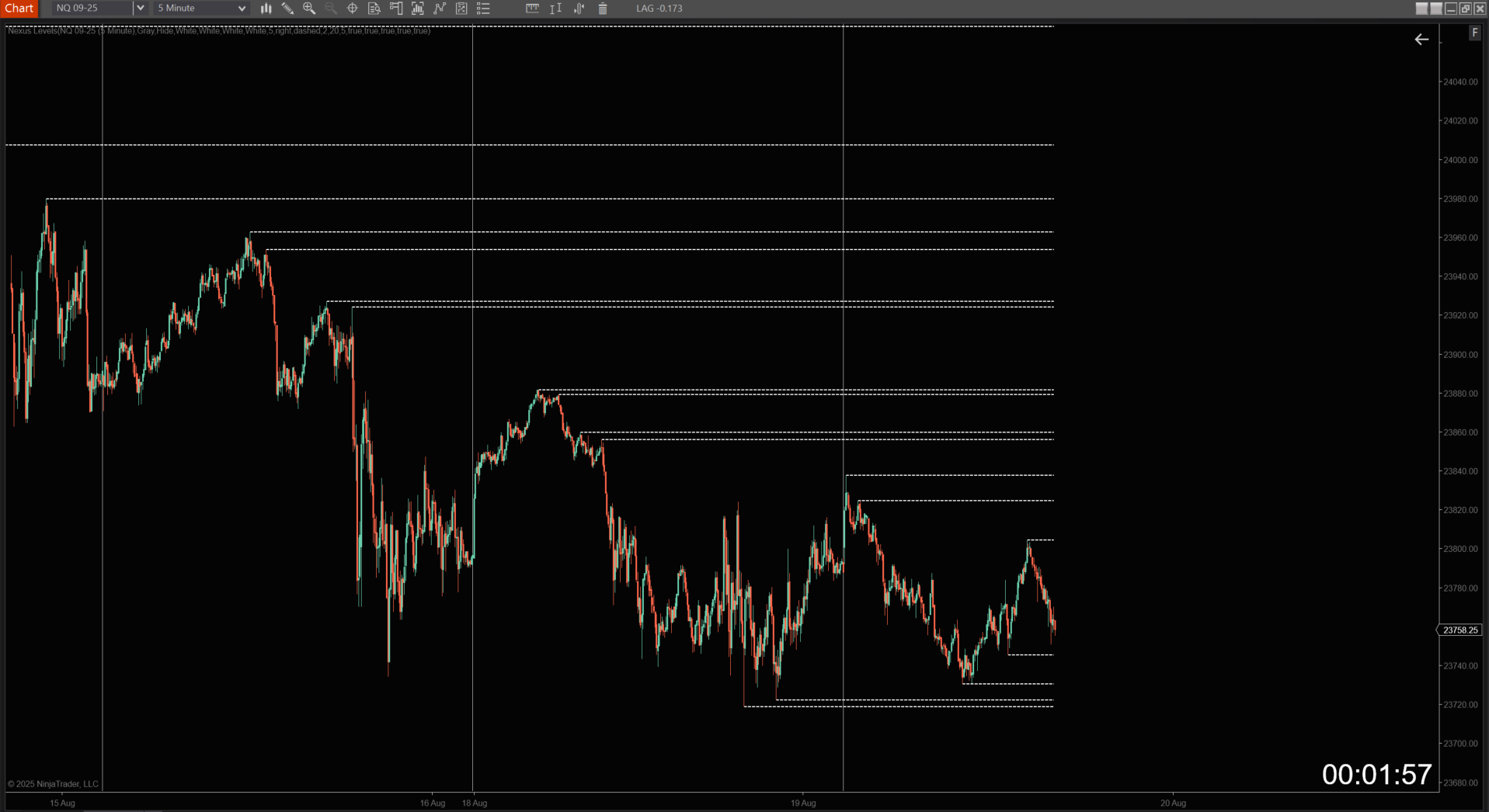
Stop guessing and start seeing. Nexus Levels automatically detects and draws key market structure points - Higher Highs, Higher Lows, Lower Lows, and Lower Highs - giving you a crystal-clear view of support and resistance.
A Clearer View of the Market
A powerful yet simple tool designed to bring objective clarity to your price action analysis.
Automatic Structure Detection
Let the indicator do the heavy lifting. Nexus Levels scans price action in real-time to identify and plot the four most critical market structure points.
- Finds Key Pivots: Automatically marks Higher Highs (HH), Higher Lows (HL), Lower Lows (LL), and Lower Highs (LH).
- Dynamic S&R Lines: Extends horizontal support and resistance lines from each level, giving you clear zones to trade against.
- Adjustable Sensitivity: Focus on major, long-term structure or dial it in to see minor, short-term pivots for scalping.
Intelligent Line Management
Keep your charts clean and relevant. Define how the indicator should react when a key level is broken by price action.
- Hide on Break: Have lines automatically disappear once broken, ensuring your chart only shows current, valid levels.
- Change Appearance on Break: Have broken levels turn grey and dotted, preserving them as potential "flip zones".
- Reduces Clutter: This automated management prevents chart blindness from too many old lines, focusing your attention on what matters.
Complete Visual Customization
Tailor every visual element to perfectly match your chart theme and personal trading style.
- Toggle Levels: Don't need to see every structure point? Easily turn any of the four level types (HH, LL, HL, LH) on or off individually.
- Custom Colors & Styles: Assign unique colors to each level. Adjust line style (solid, dashed, dotted) and thickness.
- Control Line Extension: Decide how far the support and resistance lines extend across your chart.
Get Started with NinjaTrader & Free Data
NinjaTrader is always free for advanced charting, backtesting, and simulation. Get started with free EOD data from Kinetick, our recommended data provider.


Enhance Your Trading with Nexus Tools
Combine Nexus Levels with other indicators for a complete trading system.
Get Nexus Levels Today!
The essential tool for any price-action trader who wants a clear, objective market framework.
Nexus Levels
Pay once · lifetime updates · no subscription
- Auto HH / HL / LH / LL detection
- Intelligent line management
- Full visual customization
- Works on any instrument & timeframe
- Lifetime access & updates included
Secure checkout via PayPal · instant license activation
Have questions before you purchase? Contact us.
Want Full Execution Control?
Pair It with Nexus Chart Trader
Nexus Levels displays market-structure labels. Chart Trader provides separate user-controlled order, sizing, bracket, and configurable account-limit controls.
Chart Trader lifetime · $599Frequently Asked Questions
What does Nexus Levels detect?
Nexus Levels automatically maps market structure on your NinjaTrader 8 chart - Higher Highs, Higher Lows, Lower Highs, and Lower Lows - and draws and manages the level lines for you, with no manual drawing.
How much does Nexus Levels cost?
Nexus Levels is a one-time $99 purchase with lifetime access and updates - no subscription.
Can I customize how the levels look?
Yes. Nexus Levels includes intelligent line management and complete visual customization, so you can match colors, styles, and line behavior to your chart setup.
Does Nexus Levels work on prop firm accounts?
Nexus Levels is a chart indicator rather than an account-ordering tool. Its display depends on the NinjaTrader 8 chart and data connection in use, so confirm the exact platform and data access with your provider.
What pairs well with Nexus Levels?
Traders commonly combine Nexus Levels with Nexus SuperTrend for trend context and Nexus Chart Trader to execute at structure levels with brackets and risk locks.