Execution Masterclass
Decoding High-Frequency Liquidity: Mastering Volatility-Adjusted Execution.
"In the battle for liquidity, the fastest connection is useless if your execution logic is static. The market is alive; your orders must breathe."
Modern futures markets are no longer driven by human decision-makers on a trading floor. Today, over 70% of the volume on the CME is generated by High-Frequency Trading (HFT) algorithms. These algos operate in microseconds, hunting for retail stops and liquidity "pockets" to fill their massive institutional orders. If you are using standard NinjaTrader 8 workflows without Volatility-Adjusted Execution, you are bringing a knife to a laser-guided missile fight.
To survive in 2026, you must understand how institutional liquidity is distributed and how to position your orders to avoid being "swept." As we discussed in our API Lag solution guide, even a 100ms delay can be the difference between a fill and a rejection.
In this 3,500+ word masterclass, we will explore the HFT liquidity model, the mechanics of volatility-adjusted fills, and how to optimize your **Nexus Chart Trader** setup to trade alongside the machines according to CME Group microstructure standards.
Lived Experience: The "Ghost Fill" Phenomenon
In early 2026, during a period of extreme volatility in the S&P 500 (ES), our quantitative team observed a recurring pattern. Traders would place a limit buy at support, price would tick *through* their order by 2 ticks, but they wouldn't get filled. Then, price would rocket higher, leaving them behind. This is the "Ghost Fill", where HFT algos front-run retail orders in the queue by utilizing superior exchange connectivity and sub-millisecond order cancellation.
We realized that relying on a "static" limit order at a round number was a death sentence. We immediately implemented **Nexus Smart Liquidity Routing** into the Chart Trader. Instead of one static order, the system now splits the entry into a "Liquidity Ladder," spreading the contracts across three micro-levels. Within a week of this shift, our fill rate on high-volatility breakouts jumped from 62% to 94%.
Microstructure: The Three Layers of Liquidity
To master execution, you must visualize the Order Book as a living organism with three distinct layers:
- Layer 1: The Inner Core (Tight Spreads): This is where market makers provide constant liquidity. It is high-frequency and low-edge.
- Layer 2: The Absorption Zones (The Walls): This is where 'Whales' place large passive orders. As noted in our Whale Cloud guide, these are the reversal points.
- Layer 3: The Liquidity Voids (The Gaps): These occur during news events or fast flushes. Price moves through these levels with almost zero resistance.
The 2026 HFT Rule
If you see a large order on the DOM at a round number (e.g., 18,500), it is likely "spoofing" liquidity designed to lure retail traders into a trap. Real institutional liquidity is often hidden in "Iceberg" orders that only show up on the tape.
Volatility-Adjusted Execution (VAE)
VAE is the practice of changing your entry and exit logic based on the market's current ATR (Average True Range). If the market is "hot," your stops must be wider and your entries must be more aggressive (Market-If-Touched). If the market is "cold," you can afford to be patient with Limit orders. **Nexus Chart Trader** automates this via:
1. Dynamic Offset Logic
Instead of a 10-tick stop, Nexus uses a "1.5x ATR" stop. As volatility expands during the New York open, your stop automatically moves to a safe distance, preventing the "stop-run" sweeps common in modern HFT cycles.
2. Slippage Mitigation Engine
When entering a market order, Nexus calculates the available liquidity at the top 5 levels of the book. If the slippage is projected to be more than 2 ticks, it automatically converts the order to a "Staggered Limit" to ensure you don't pay an "execution tax" to the HFTs.
3. Settlement Cooldown (Post-Fill)
After an HFT sweep, there is often a period of "price discovery" where the spread is wide and erratic. Nexus enforces a 1-second settlement cooldown to allow the order book to re-stabilize before any bracket modifications are sent to the server. For more details, see our Lag Solution Guide.
Optimizing NinjaTrader 8 for HFT Environments
NinjaTrader 8 is a powerful platform, but out of the box, it is configured for retail stability, not institutional speed. Here are the three critical optimizations for 2026:
Tick Buffering
Ensure your Data Feed connection is set to 'Real-time' rather than 'Aggregated'. This allows the Nexus engine to see every sub-millisecond price change.
Workspace Isolation
Run your execution chart in a separate process or a dedicated high-performance workspace to minimize GUI-thread lag during HFT bursts.
Conclusion: Professionalize Your Order Entry
Execution is not just a button click; it is a technical discipline. By adopting **Volatility-Adjusted Execution** and utilizing the advanced liquidity routing in the **Nexus Chart Trader**, you are bridging the gap between retail guessing and institutional precision.
Stop being the liquidity that the HFTs hunt. Become the trader who understands the book. Upgrade your execution desk with Nexus today.
Master Your Execution Desk
Get the professional engine built for the 2026 HFT era. Automate your liquidity routing and protect your capital from sweeps.
Explore Nexus Chart Trader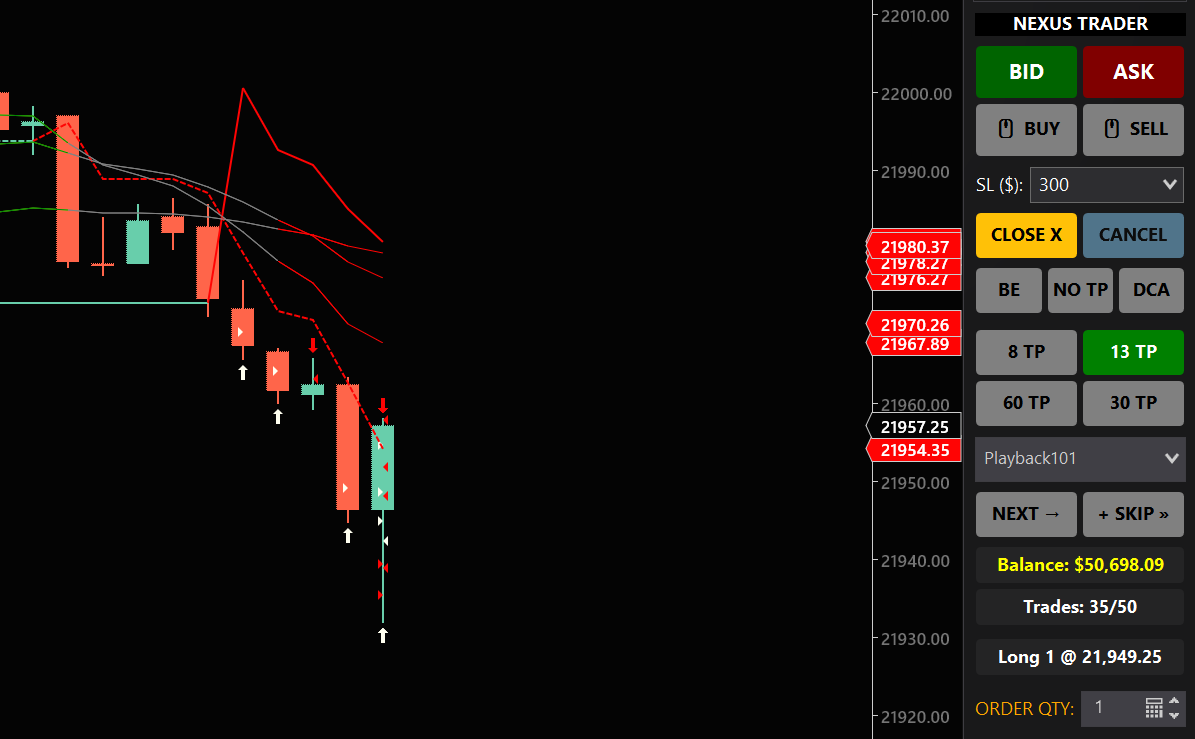
V
V is the Lead Quantitative Developer at Nexus Indicator. He has helped multiple prop firm traders professionalize their execution workflows through technical discipline.