Trade less from memory, review from evidence. Nexus automatically captures your executions and turns account costs, payouts, screenshots, and behavior into a review system you can actually use.
Automatic CaptureExecutions enter the journal without retyping every fill.
Full-Business P&LConnect trading results with evaluations, resets, fees, and payouts.
Evidence-Led ReviewKeep notes, emotion tags, sessions, and screenshots with the record.
Owned LocallyJournal files remain on the computer running NinjaTrader 8.
The Review System
From execution to understanding.
The same local trade record powers every view, so you can move from a single fill to the broader pattern without rebuilding the story in a spreadsheet.
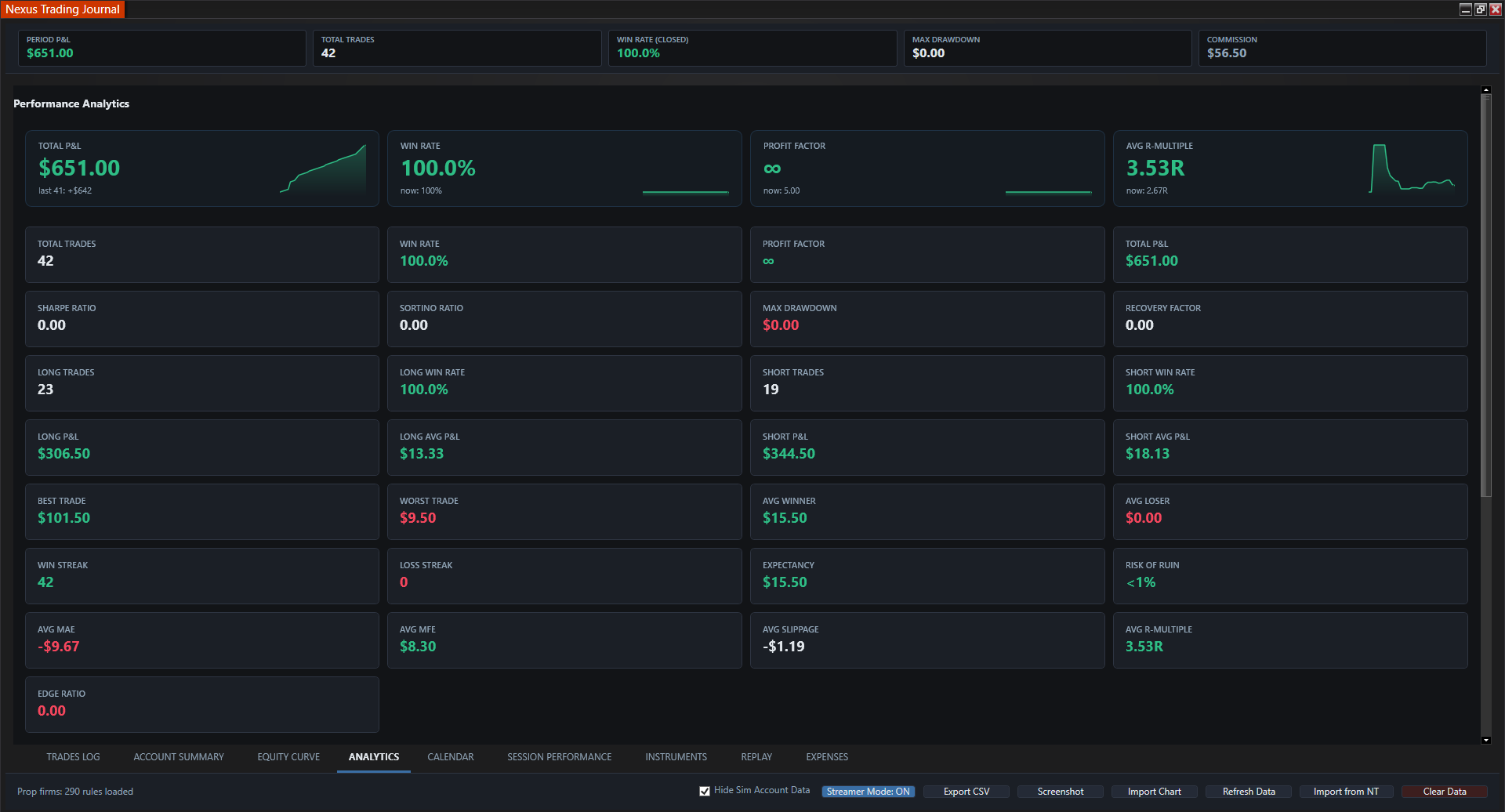
01 / ANALYTICS
See the structure behind the result.
Review win rate, profit factor, expectancy, drawdown, average winners and losers, streaks, MAE, MFE, and the performance measures that explain more than a final P&L number.
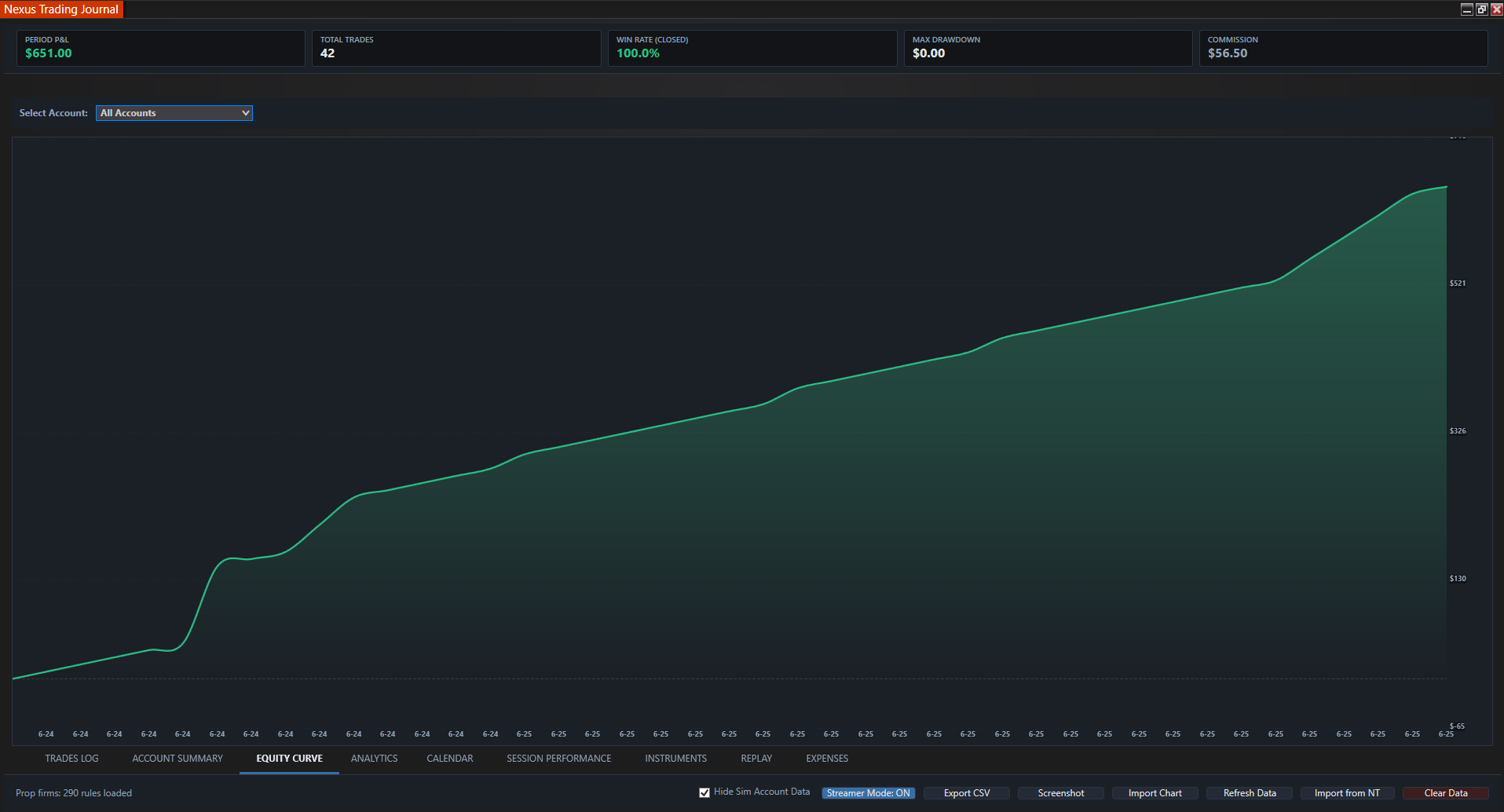
02 / EQUITY
Know whether the curve is improving or just recovering.
Track account growth and drawdown over time, then connect changes in the equity curve with the trades, sessions, and decisions that produced them.
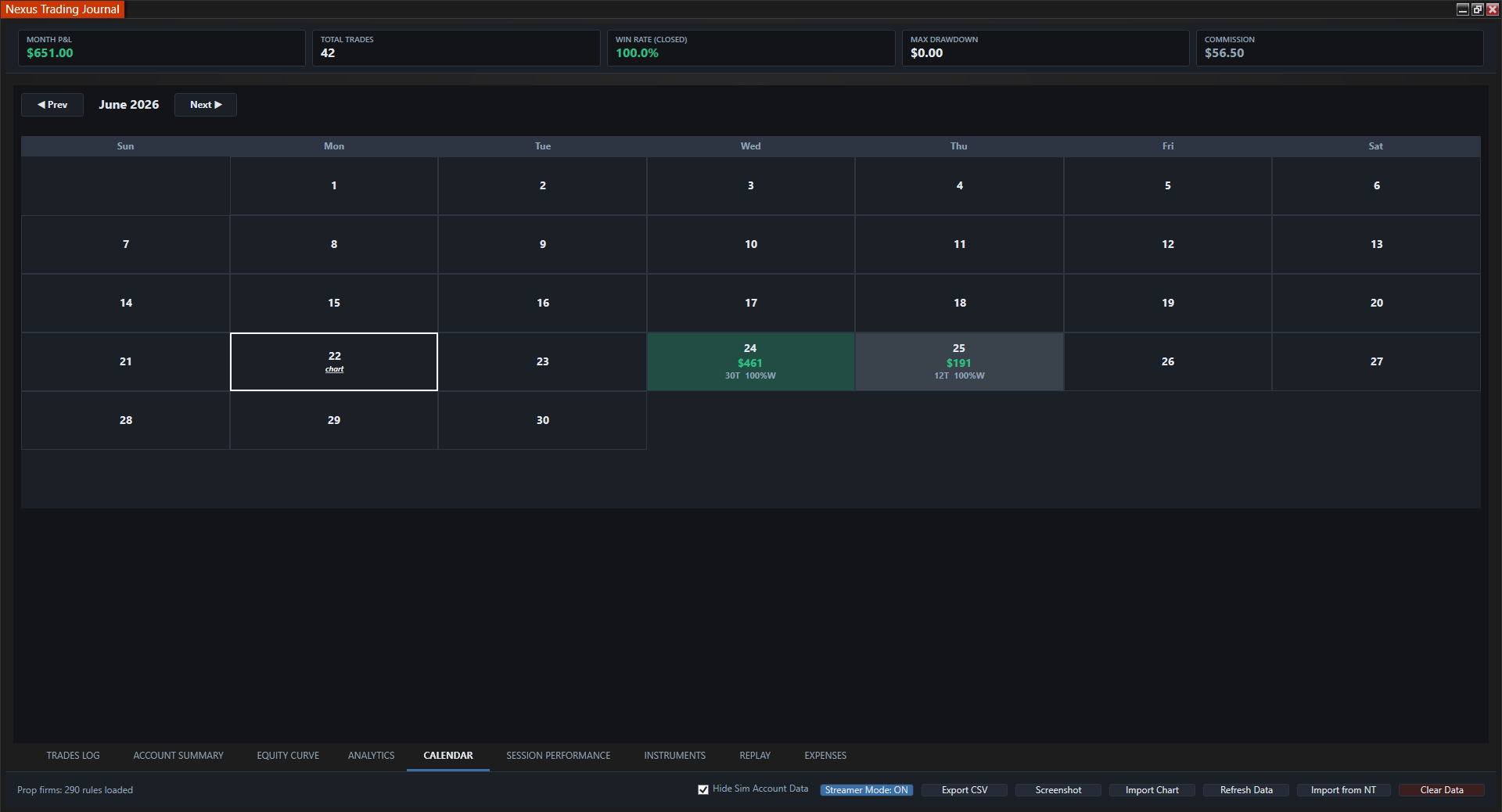
03 / CALENDAR
Turn each trading day into a reviewable record.
Use the daily P&L calendar to spot clusters, revisit specific sessions, and attach chart screenshots to the dates where context matters most.
Beyond the Trade
The P&L never tells the whole story.
Trading is an operation. Nexus Journal connects the trades with the expenses, payouts, sessions, screenshots, and review context that determine whether the operation is actually working.
01
Trade Log
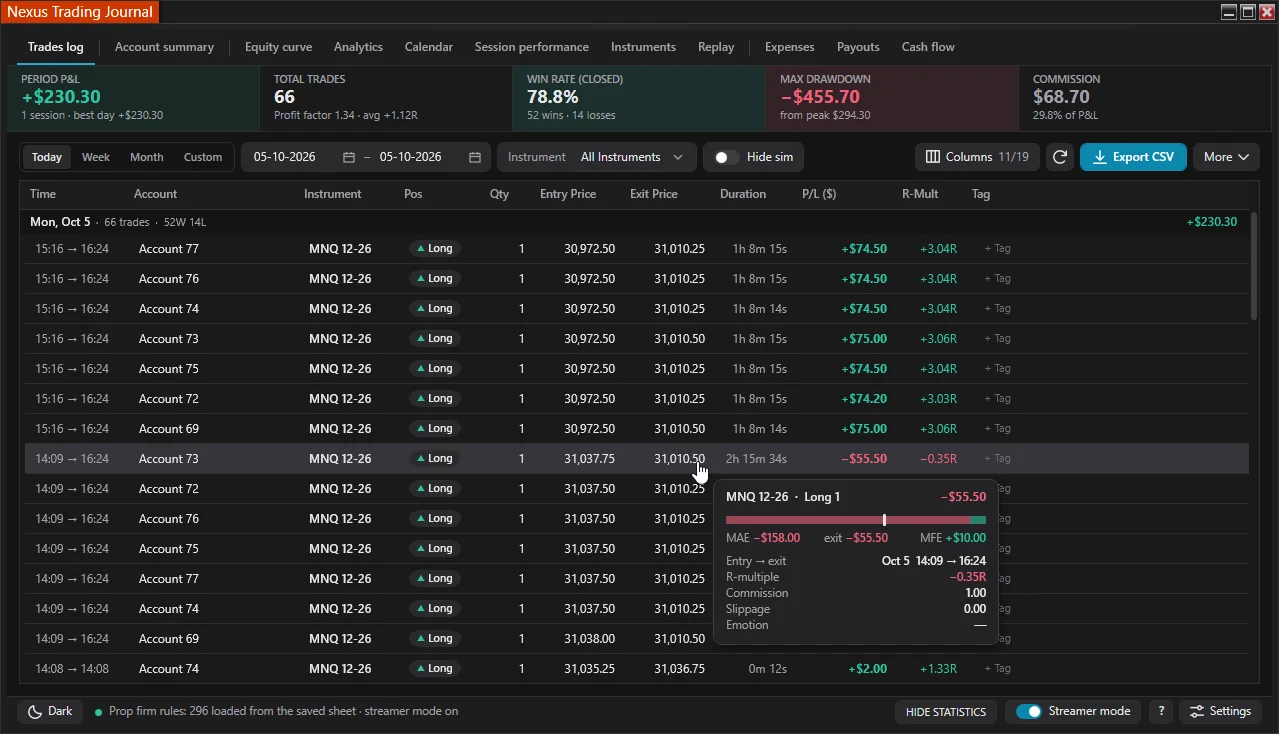
Executions, P&L, MAE, MFE, slippage, tags, notes, and emotion context.
02
Expenses
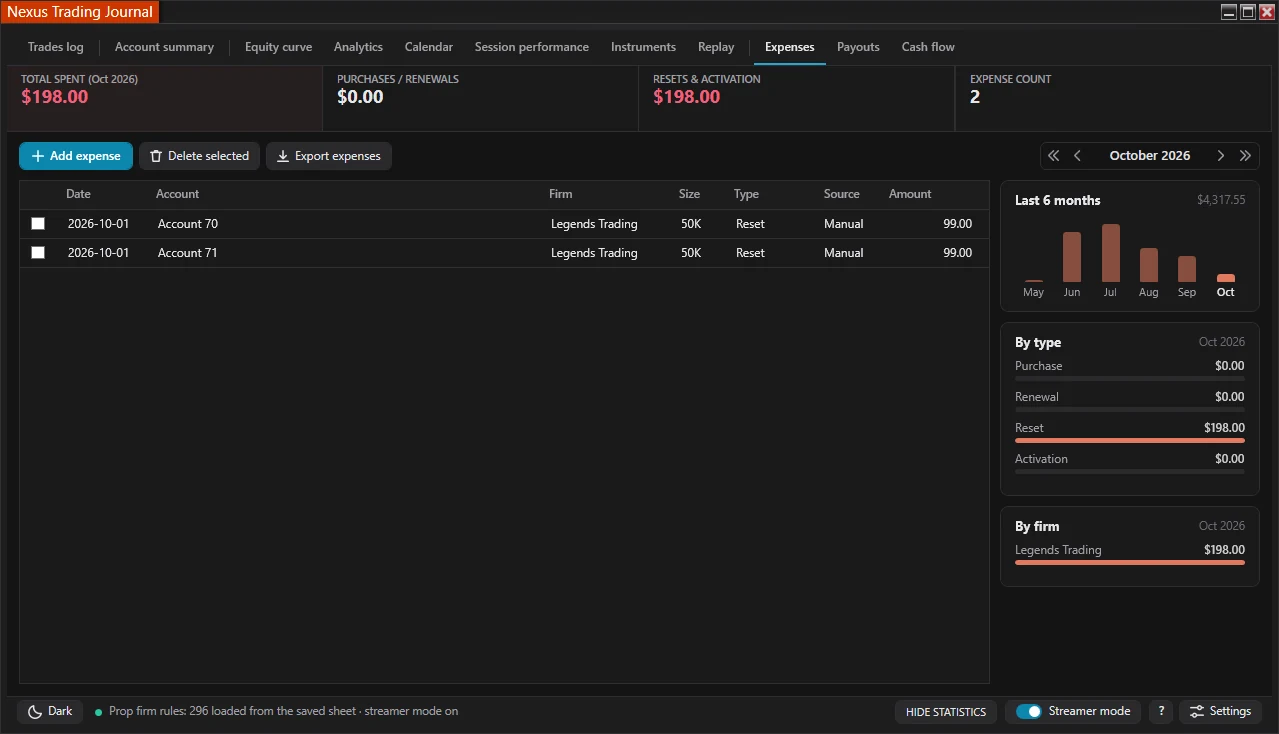
Track evaluation purchases, resets, activation fees, and other operating costs.
03
Payouts
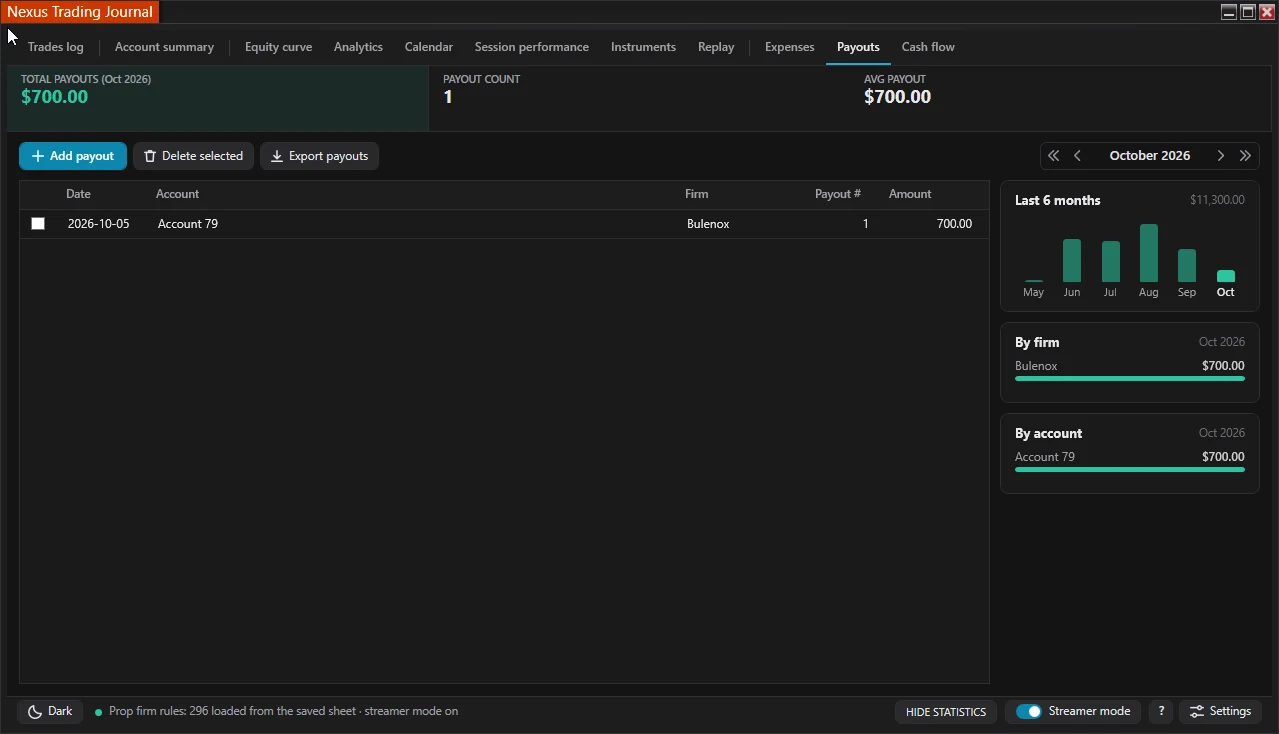
Log prop-firm payouts manually and keep realized cash movement visible.
04
Cash Flow
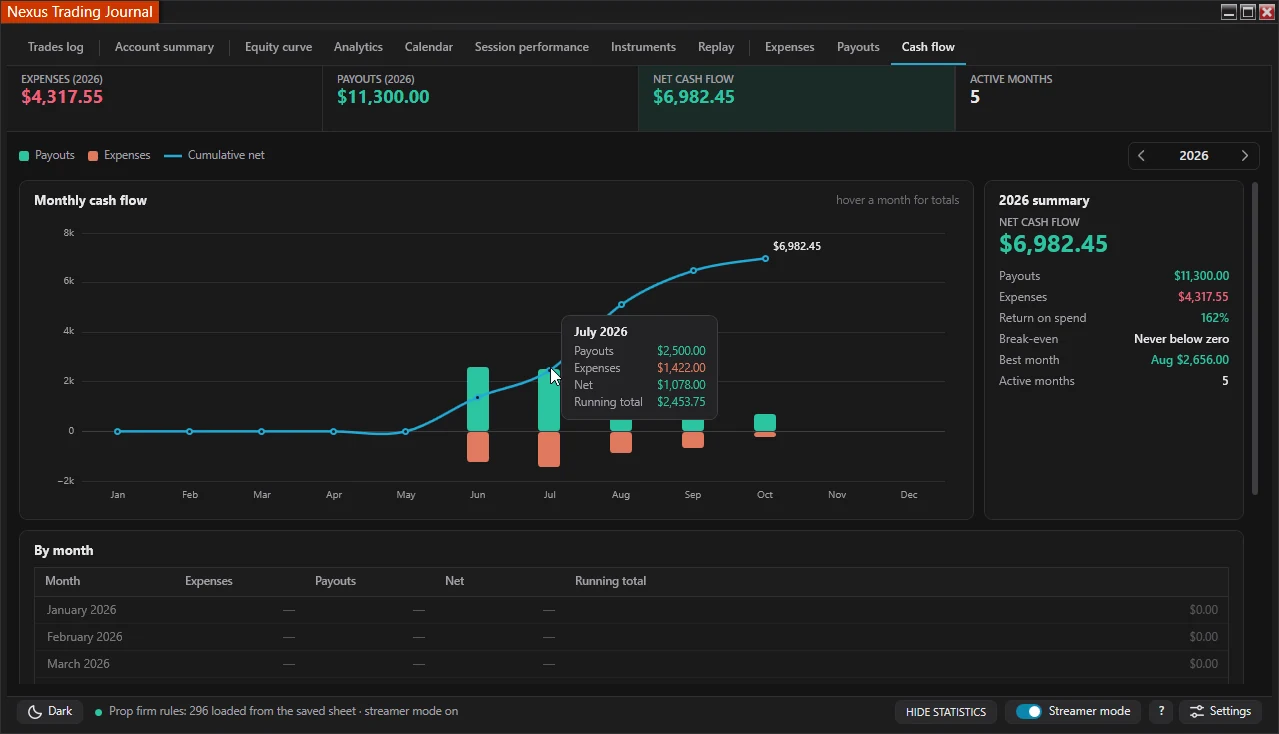
Combine trading results, expenses, and payouts in one monthly operating view.
05
Replay & Sessions
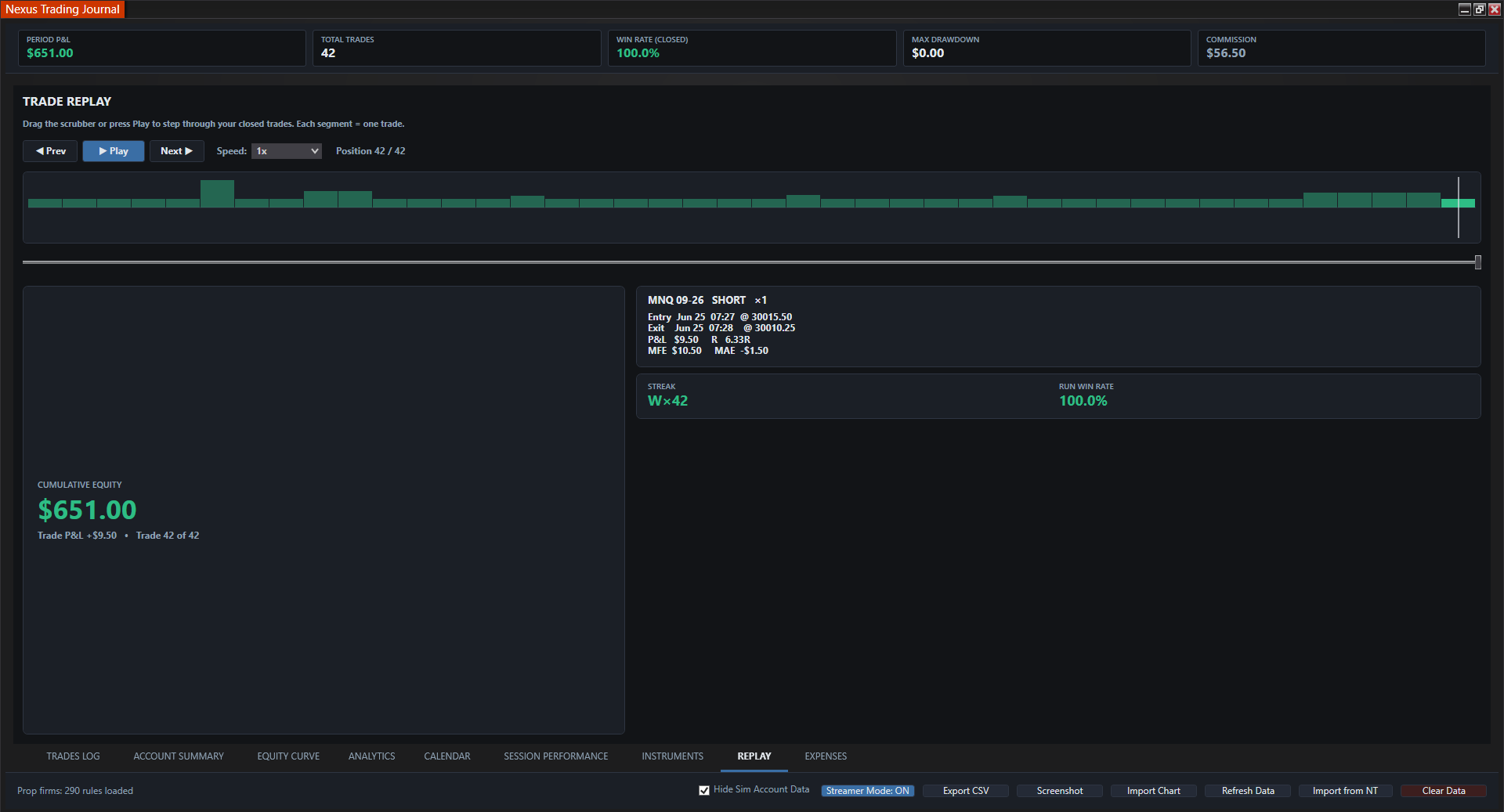
Step through past trades and compare performance by trading session.
06
Sim / Live Control
Record simulation and live executions, then hide simulation data when required.
Local by Design
Your trading record stays with you.
Nexus stores journal data in local files on the computer running NinjaTrader 8. There is no cloud journal account to maintain and no recurring plan required to keep using your review system.
Local Journal FilesRecords remain on your trading computer.
CSV ExportExport the currently visible trade set when needed.
Lifetime AccessOne purchase with included product updates.
Standalone Add-OnNo other Nexus product is required.
Own the System
A better review process starts with a complete record.
Enter your NinjaTrader Machine ID (Help > About) at checkout for license activation.
Questions
The details, plainly.
Is the Nexus Trading Journal a standalone NinjaTrader 8 add-on?
Yes. It runs as a standalone NinjaTrader 8 add-on and does not require Nexus Chart Trader or another Nexus product.
Can I review simulation and live account trades separately?
Yes. The journal records NinjaTrader 8 simulation and live account executions. The Hide Sim Account Data control removes simulation and playback records from the journal views, and the preference is saved between sessions.
Can I attach chart screenshots to the journal?
Yes. You can attach chart screenshots to calendar days so the images stay with the daily P&L review.
Does the journal capture executions automatically?
Yes. The journal captures NinjaTrader 8 executions automatically and uses them to build the trade log and analytics. You can still add notes and emotion tags manually.
Where is the journal data stored?
Journal data is stored in local files on the computer running NinjaTrader 8. The journal does not require a cloud account, and you can export the currently visible trades to CSV.
Is there a monthly fee?
No. The Nexus Trading Journal is a $399 one-time purchase with no monthly subscription.
Does the journal track prop firm expenses and payouts?
Yes. Expenses can be added or edited, payouts are entered manually, and the Cash Flow view combines those records with trading results.
How does local storage compare with a cloud journal?
Nexus keeps its journal data in local files on your computer and uses a one-time purchase model. Third-party journals may use provider-managed storage, subscriptions, and different export or privacy terms, so review each provider's policies before choosing.
Nexus Trading Journal for NinjaTrader 8
Your trading edge, made measurable.
Automatically capture every execution, understand what drives your results, and review the full business behind your P&L—all inside NinjaTrader 8.
Trade Log · Automatic execution capture and reviewNinjaTrader 8
Automatic CaptureExecutions flow into your journal
One Review SystemLogs, analytics, calendar & replay
Stored LocallyJournal files stay on your computer
Lifetime AccessOne payment, no subscription
A Journal You Own
Your trading record stays close to the work.
Nexus stores journal data in local files on the computer running NinjaTrader 8. There is no cloud journal account to maintain and no monthly subscription attached to your review history.
Keep the journal on the workstation where you trade and review.
No Monthly Fee
$399 once for lifetime access and included updates.
CSV Export
Export the visible trade set when you need a portable copy.
Review Context
Keep notes, emotion tags, and daily screenshots with the record.
Inside the Workspace
One clear view of the whole trading business.
Move from individual executions to account-level performance, operating costs, payouts, cash flow, and repeatable review.
Trade Logs
Auto-captured P&L, MAE/MFE, slippage, tags.
Expenses
Evals, resets, and activation fees, auto-tracked and editable.
Payouts
Manual payout entries by firm and account.
Cash Flow
Monthly bar chart of net prop firm results.
Analytics
Profit factor, win rate, expectancy, drawdown.
Equity Curve
Growth, peak equity, and max drawdown.
Calendar
Color-coded daily P&L heatmap.
Replay
Step through past trades and execution.
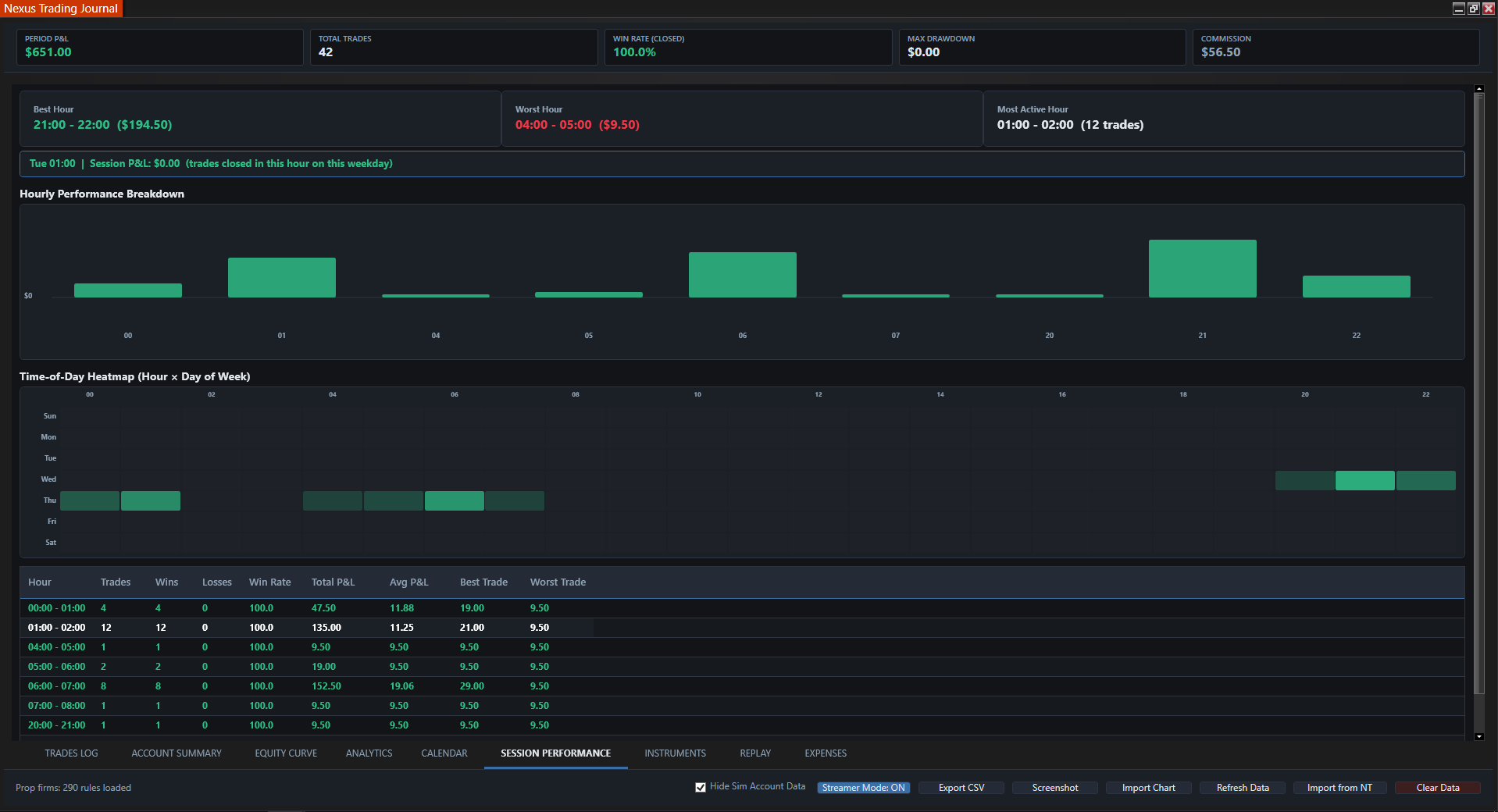
Session Performance
Results by session and time of day.
Everything Included
A complete review system, not another trade list.
A standalone NinjaTrader 8 add-on that connects execution records, operating costs, analytics, and review context.
Auto Trade Logging
Tick-accurate entries and exits from NT8 with P&L, MAE/MFE, slippage, emotion tags, and CSV export.
Expense Tracking
Eval purchases, resets, and activation fees logged automatically. Add, edit, or delete any entry manually.
Payout Logging
Record funded payouts manually by firm and account so you know what you actually took home.
Cash Flow
Monthly bar chart of net prop firm performance, trading results minus the real cost of evals and resets.
Performance Analytics
Profit factor, expectancy, win/loss ratios, and average winner vs loser.
Equity Curve
Live performance curve with max drawdown and peak equity tracking.
Daily Calendar
Green/red heatmap with quick-view P&L and screenshot attachments per day.
Replay & Sessions
Review trades in sequence and break down results by trading session.
Local Storage
Journal records are stored in local files, and visible trade records can be exported to CSV.
Designed for Deliberate Review
Built for traders who treat review as part of execution.
It is built for NinjaTrader 8 users who want automatic trade records and a repeatable review workflow without maintaining a separate cloud journal.
Active NinjaTrader 8 traders
Capture executions into a trade log, then review P&L, analytics, the equity curve, sessions, and calendar results in one add-on.
Simulation and live account reviewers
Record both account types, then use the saved Hide Sim Account Data control when you want views focused on live or funded-account records.
Multi-account and prop firm traders
Compare account results, add expenses and payouts, and review how trading outcomes and business costs affect cash flow.
Traders who prefer local journal files
Keep journal records on the computer running NinjaTrader 8 and export the currently visible trades to CSV when needed.
The Review Workflow
Capture the facts automatically. Add the human context deliberately.
A spreadsheet depends on you entering fills, maintaining formulas, and organizing chart images after each session. Nexus captures NinjaTrader 8 executions automatically and uses them to build the trade log, analytics, equity curve, and P&L calendar. Manual input remains available for the context software cannot know, including notes, emotion tags, expenses, payouts, and chart screenshots.
Automatic capture. Execution records populate the journal without retyping each fill into a spreadsheet.
Consistent views. The same records feed the trade log, account views, analytics, equity curve, calendar, and session review.
Manual context stays editable. Add notes, emotions, costs, payouts, and screenshots where human judgment is required.
Local files and CSV export. Records stay on the NinjaTrader computer, with CSV export for the visible trade set.
Is the Nexus Trading Journal a standalone NinjaTrader 8 add-on?
Yes. It runs as a standalone NinjaTrader 8 add-on and does not require Nexus Chart Trader or another Nexus product.
Can I review simulation and live account trades separately?
Yes. The journal records NinjaTrader 8 simulation and live account executions. The Hide Sim Account Data control removes simulation and playback records from the journal views, and the preference is saved between sessions.
Can I attach chart screenshots to the journal?
Yes. You can attach chart screenshots to calendar days so the images stay with the daily P&L review.
Does the journal capture executions automatically?
Yes. The journal captures NinjaTrader 8 executions automatically and uses them to build the trade log and analytics. You can still add notes and emotion tags manually.
Where is the journal data stored?
Journal data is stored in local files on the computer running NinjaTrader 8. The journal does not require a cloud account, and you can export the currently visible trades to CSV.
Is there a monthly fee?
No. The Nexus Trading Journal is a $399 one-time purchase with no monthly subscription.
Does the journal track prop firm expenses and payouts?
Yes. Expenses can be added or edited, payouts are entered manually, and the Cash Flow view combines those records with trading results.
How does local storage compare with a cloud journal?
Nexus keeps its journal data in local files on your computer and uses a one-time purchase model. Third-party journals may use provider-managed storage, subscriptions, and different export or privacy terms, so review each provider's policies before choosing.